Wednesday, May 25, 2011

Tumble Lube & Your 357 Magnum Revolver

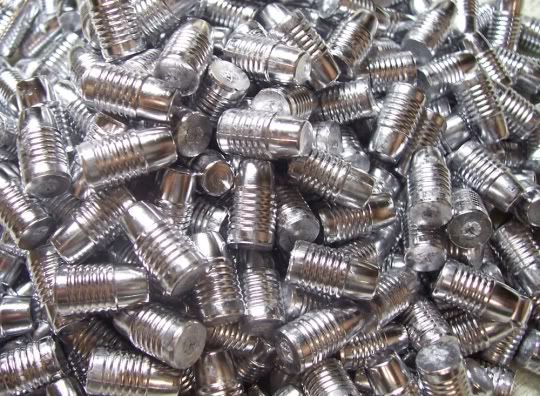
Tumble lube works, and is a great way to lube your cast bullets.  If you are new to tumble lubing, the basic process is published in the Lee Instructions.  These directions are very good, short, to the point and cover the basic process.  The two favorite approaches below are based upon these steps.

Tumble lube works on standard lube groove bullets, as well as on tumble-lube-bullets.  Your should try these approaches to see how they work for you, and see which one your 357 revolver likes the most.

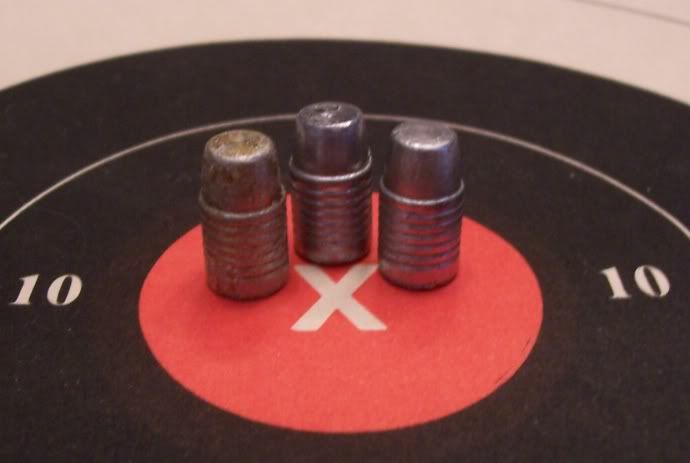
Here are three TL358-158-SWC bullets, one of the most accurate and best designed bullets that I've found.  The first is lubed with Lee Liquid Alox (LLA) mixed with mineral spirits, followed by a dusting of mica.  The middle bullet is a clean, sized bullet to act as a reference.  The third is lubed with Johnson Paste Wax:


Approach 1

  • First:  Prepare the bullets with WD40, lightly spray a bunch of bullets spread on a paper towel, and then run them through the sizer (don't let them dry before sizing).  This avoids having to lube twice.  It takes time for them to dry, which can be avoided and isn't needed.  A penetrating oil/lube like WD40 isn't good for gunpowder, however the lube will coat it, and prevent any problems.
  • Second:  Prepare the lube, mix your Alox with Mineral Spirits, 2/1.  This mix cuts the pure Alox or Xlox, making for a thin even application.  Unless too much lube is used, it dries nicely, with very little stickiness.
  • Third:  Tumble lube per the Lee instructions, then spread on wax paper to dry.  Use a small fan to help the lubed bullets dry more quickly, if one is handy.
  • Fourth:  Put the lubed bullets into another container, add a small (very small) amount of mica and swirl it around.  Just like lubing.
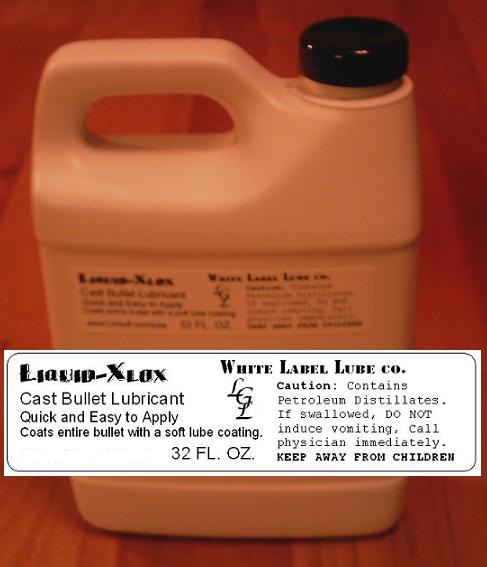
Your are ready to load and shoot.  While Label lubes offers a great alternative called Xlox:


The mica can be bought from Midway, and probably other online sites too:


Approach 2

Johnson Paste Wax is becoming my favorite lube, it's awesome.  However testing isn't complete, hot loads will be put through the paces soon.  For lighter loads, the jury is in, it can't be beat in my opinion.  It lubes great, is accurate, and less messy than traditional lube or liquid Alox.  

Update: JPW works great with tumble lube design bullets.  However it did fail to lube a 170 grain Keith bullet, resulting in leading.  Keep that in mind when lube your bullets.  I plan to shoot a lot more of it with light, very accurate loads.  For full house Keith bullets I will continue to Lubrisize with Darr lube.


  • First:  Prepare the bullets with WD40, lightly spray a bunch of bullets spread on a paper towel, and run them through the sizer (don't let them dry).  This avoids having to lube twice, once before lubing.  It takes time for them to dry, which can be avoided.  A penetrating oil/lube like WD40 isn't good for gunpowder, however the lube will coat it, and prevent any problems.
  • Second:  Put the bullets into a plastic bag or container and let is sit for 5 minutes in hot tap water. This will warm the lead and will help the wax coat evenly.  They should be slightly warm to the touch, not hot and not cool. 
  • Third:  Scoop a small amount of the Johson's Paste Wax into a container of bullets.  For 200 bullets, try a dime size glob of wax.
  • Fourth:  Tumble lube just like Approach 1, then spread on wax paper to dry.  Use a small fan to help the lubed bullets dry more quickly, if one is handy.
Your are ready to load and shoot.

In Conclusion:

There are many other approaches that work too.  However, these are the techniques I use most often these days and just may work well for you too.

One other very noteworthy approach was created by Recluse, a member of castboolits.gunloads.com.  He created a mix called 45/45/10 that is hugely popular.  It's 45% LLA, 45% reduced JPW and 10% mineral spirits. Search with Google and you'll be able to find it quickly.   The detailed instructions are excellent and are available at that forum.

Shoot well!

There is a follow on post at: http://357shooter.blogspot.com/2011/06/update-best-way-to-lube-best-cast.html

Sunday, May 15, 2011

Notes: Lee TL358-158-SWC Lapped for Testing, 700X & Variation / Issues, RCBS 38-150SWC Mention

A Lee TL358-158-SWC 6 cavity mould arrived the other day.  After buying & selling many moulds, I wanted to revisit this fine design, looking to refine the tumble lube process. Wow, this new mould dropped very small bullets. The .357 to .358 bullets are not what I expect.

Time to lap another mould.  To get each cavity to over .360 took a little longer.  Lapping it slowly and taking measurements often, now it's dropping these fully sized bullets.  Oh, this mould is casting great at 800-850 degrees.  I think the tumble lube grooves fill out easier then the grooves on a 358-429 mould.  The lack of deep squared off Keith grooves makes a difference:


They now weigh in at 163 grains when using 98% lead and 2% solder.  This newly-lapped mould has improved accuracy compared to the unlapped-one used originally.  When enough testing is complete the charts will get updated.
Early results using 5.3 grains of Unique look promising.  If it proves to be consistently accurate it will get added to the most accurate chart.

Now, info on 700X:  After loading many pounds of this powder, it finally has/had accuracy issues.  Just recently, 2 different canisters proved to vary quite a bit.  More than bumping the charge up or down 2-3 tenths of a grain.  Powders can vary 10% and still be in tolerance, but if you run into unexpected results, it could a bigger variation of the powder than usual.  There was no safety problem or concern, however groups opened up to the point of being horrible and at any charge - inaccurate.

I still have a 3 cannisters and will verify the third unopened cannister in the next few weeks.  In the mean time, further test will be with HP-38, H110 and Unique.  The first 2 are proven accuracy producers.  Unique is now at the top of the accurate powder poll.  In the past, it shot well, but wasn't one of the best.  I added it to the mix to revisit and see how it does.

As always, the results based on caliper-measured-groups will determine if it really does deserve to be on the Most Accurate Bullet Moulds and Loads Table.

In closing this update: Recently tests using the RCBS 38-150-SWC have shown it's a good shooter.  But so far not consistent enough to make the list.  It may work well in your revolver, but until it proves itself in my Taurus 66 it gets "try it if you'd like" mention, off-list.

Sunday, May 1, 2011

Lapping a Mould: What to do if your mould is dropping small bullets

We've all had a mould that dropped small bullets.  It's expensive to send it out for machining, and the manufacturer may fix it how you want, but in many cases is a hit or miss proposition.  

You can fix it with a few tools. Carefully follow these steps and you can improve the bullets that you cast and shoot.  This translates to tighter and more consistent group sizes at the range.

First, here are a few 358-429 Keith's cast with a lapped aluminum mould, they are already sized and lubed:


There's various ways to lap a mould.  This is one technique that works well and is proven. This 358-429 mould is aluminum with 5 cavities.  The number of cavities doesn't matter, however other materials take longer and are more difficult to lap. 

The process, step-by-step:

1) Get some nuts, for 357 I use 1/2 inch, one per cavity
2) Heat the mould to casting temp                             
3) Open the sprue plate and rest a nut over each cavity


4) Cast through each nut, overfilling by a little bit.  If it runs a bunch,that's OK (if not full enough the nut may spin on the lead)
5) Drop'em out as usual, and let it all cool
6) Lightly coat the bullet with compound (note below)

The bullets in the picture below have already been used to lap.


7) Put each bullet back into the cavity it came from (twist off the lead if it keeps a wrench or socket from fitting the nut)
8) Either with a wrench or with a electric drill/socket start slowly lapping, while applying pressure on the handles.  Use a c-clamp (if handy) to tighten down the cavity being lapped, adding pressure slowly.  Lap each cavity for 1 minute (longer if by hand) per lapping session, and vary the speed and reverse direction if possible.   Keep it slow and you'll be good


9) Clean it up and go-to step 1

That's the process.  Use the cast bullets to actually do the lapping, in the same cavity they were cast in.  Measure each newly cast nut-bullet at a couple of points, like on the seam and then across the seam. Lap each cavity enough times to get the size you want, or just to polish it.  I lapped mine 3 times with 600 grit compound and 1 time with Rubbing Compound.

The lapping compound can be something like Wheeler 600 grit, auto rubbing compound (used this for the final-lap or polishing as it is very fine) or even toothpaste for polishing only.  Valve compound works too.

Because I use a lubrisizer, I wanted to get the minimum measurement to .0004 over my final size.  So with a .360 size as the goal, the minimum I wanted is .3604. If you don't size your bullets, just stop when each cavity is at the right size.

Benefits of a lapped mould:
  1. The bullets just fall out of a lapped mould.  
  2. Sizing  & lubing is easier as lube doesn't shoot-the-gaps and flood the die.
  3. The best result is having fully sized bullets and not only shooting smaller groups but shooting them more consistently too
Lapping a mould is messy, so between sessions wash the mould at a sink with Dawn or something similar.  For a 5 cavity mould it takes 15-20 minutes for 2 lapping sessions.  So it doesn't take long.  Go slow and keep the stress down.
 
Good shooting!

Sunday, April 17, 2011

Annealing Lead Alloy for Softer Boolits - Final Hardness Results

To the new folks, there is a description of the Annealing test in the 2 prior posts.  To the regulars, welcome back for another visit.  Now, to the test results:

The hardness continues to increase, at a rate much like air cooled WW alloy.  After 14 days it's up to 12.5 BHN.  Annealing works incredibly well, for a week or two.  That's something to keep and mind and will aid you in making use of this information in the future.

For an afternoon plinking, it's probably not worth the effort.  For an event, or for a test day at the range, it can make a huge difference. 

Freezing the annealed bullets is a way to keep them soft for a longer period of time.  Testing the effectiveness of freezing is in the plans, so stay tuned for more analytics, charts and results.


Sunday, April 10, 2011

Annealing Lead Alloy for Softer Boolits - First Results

For background on this test, please read the prior post.

The cast bullets used in this test were annealed for 30 minutes at 450 degrees.  The oven was turned off, with the bullets inside, until cooled.

Here is the data in chart format, click on the chart to see it full size:


This particular air cooled wheel weight alloy tested as 10.4 BHN, the day after casting.  A bit hard, but in the range of modern day wheel weights.  After six weeks and just prior to annealing they tested at 14.2.  Immediately after cooling they dropped to 8.2.  That's a pretty big drop in hardness.  After 7 days they age harden back to the 10.4 as-cast hardness.

I plan to test them again next week to verify just how they continue to harden.

It's a nice surprise that the hardness dropped to 8.2, just what I had hoped for.  As you can tell, they don't stay there long.  If you cast & load with a just in time approach, this can be very helpful.  If you cast thousands of bullets to be loaded over the next year, you can still anneal in smaller batches, as needed.

It's encouraging to know that the wheel weights can be softened.  The consistency and accuracy achieved in a 357 Magnum with softer lead is measurable and noticeable. 

I plan to roll this new-found-knowledge into my current casting-handloading-shooting schedule.  Currently I cast 5-10 lbs of a given bullet, let them age for 2 weeks, lube & size them.  At that point they are ready to load then shoot.  Usually lasting for 2-4 weeks.  That's with 2 different bullet designs going, shooting 200-250 total rounds a week it works.  Now I'll anneal-lube-size a week in advance for bullets that need to be a softened up.

Hope this helps and gets you to 1 ragged hole at 25 yards.

Monday, April 4, 2011

Annealing Lead Alloy for Softer Boolits - The Approach

Since my supplier of pure lead is drying, the problem is how get bullets of BHN 8 or less casting with wheel weights.  Softer lead bullets provide consistent accuracy, as compared to BHN 11, or 16 or harder.  A well designed bullet, sized to perform in your revolver (often .360 works, but some revolvers vary) can produce great groups, even if it's a harder than BHN 8.  However, softer alloys produce better groups, and do it more consistently.

Strange as it sounds, the process to soften wheel weight alloy bullets is much like the process to harden them.  The difference is, to soften the bullets, they don't get quenched in cold water.

The goal of the upcoming test, is to verify that bullets can be softened to BHN 8, or as close to it as possible.  If they can be softened, does it last more than a few days or does it last for weeks.  Since it takes a long time to verify test results, it will be about a month before I can post the resulting data.

The process is to heat the bullets in the oven, then turn it off and let them cool to room temp.  It can take a couple of hours to cool slowly.

The initial results will be for pure wheel weights, additional tests will verify the impact of adding additional tin.  Which is reported to soften the bullets even more.  Pretty great if it all works out.

The planned test will:

1) Heat bullets in the oven, set to 450 degrees, for 30 min
2) Turn it off, let the entire oven with bullets inside cool to room temp
3) Test the bullets hardness before heating, after heating and then at 7 day intervals
4) Report the results here


To achieve the best accuracy, shooting a softer alloy makes all the difference.  That is, in 357 magnums of course.  Not that I'm closed minded, but it is the most fun caliber to cast, handload and shoot, bar none.

Saturday, March 26, 2011

Lyman 358-477 : 150 grain SWC: Accuracy Results

Accurate results with the lighter bullets has been impossible, so far. Today with a medium crimp and  loaded over 3.5 grains of 700X, success!   A very accurate sub-1-inch 5 shot group of .69.  That makes the 358-477 one of the best moulds for the 357 Magnum revolver.  The actual bullet looks different than Lyman's website:


As always, that's with a Taurus 66, 6 inch barrel, from at rest at 25 yards.  The Taurus is now carrying a Simmons 4X scope which is very effective.  Here's a picture, the 358-477 group is the first target:


The updated details of the load are in the Most Accurate Bullet Moulds and Loads Table

Additional tests are planned to further refine the OAL, which is very important for this bullet.  I will be testing magnum powder charges in the future, but the initial results are not worth mentioning so far.  That may change, and the results will speak for themselves.

The 358-477 works great loaded long, tested with a OAL of 1.620 (a little shorter may work) and lubed with Darr lube. 

FYI:  NRA lube is quickly becoming my favorite, and works well with all 357 bullets, including this one.  The high quality and the low price of the hollow sticks from White Label Bullet Lube make it a great value.  NRA has been a favorite for cast bullet shooters for years, and with good reason.

The 358-477 is super accurate, with light recoil and very economical to shoot.  The Lyman steel/lead moulds cast great and won't break the bank.  Available new in 2 cavity and 4 cavity versions and available from all the web-sites that sell resloading / casting equipment.  Midsouth has the best price right now, at least that I can find.

Sunday, March 20, 2011

357 Magnum Cast Bullet Crimping

A short note on the roll crimp used for cast bullets:  Nothing in casting and handloading works for everyone, for all guns, for all reloading presses and in all instances.  Crimping is just like that.  You will have to adjust a bit, but crimping does affect accuracy and is important.

I do know the Lee crimping dies and the Dillon Square Deal B dies do work with these adjustment specs (note: the Lee FCD can cause problems. For accurate cast bullets that are oversize at .360 diameter, a regular roll crimp die works best.): 

Crimping cast boolits without a groove, or crimping on the driving band:  This takes pure experimentation.  The Lyman 358-429 crimped onto the front band works well with a light roll crimp.  It's important to crimp enough so the bullets don't jump out of the case due to recoil, and not to much crimp or it will ruin accuracy.

The 700X and HP38 loads in the Most Accurate Boolits and Loads Chart have a medium crimp.  The 700X 5.1 load and all the H110 & 2400 magnum loads have a heavy crimp.

What does this mean?  First, here's how I zero the crimp:

  1. Back out the crimp die
  2. Size a fires 357 magnum case
  3. Place the case under the crimp die and raise the ram (don't use a flared case)
  4. There should be no contact between the crimp die and the mouth of the case
  5. Holding the ram up, Screw in the crimp die until it make firm contact
  6. Now the crimp is  zeroed
Once you are at this point, lower the ram and screw in the crimp die to the crimp needed:
  • Light crimp = 1/2 additional turn of the crimp die from zero
  • Medium crimp = 3/4 additional turn of the crimp die from zero
  • Heavy crimp = 1 additional turn of the crimp die from zero
This isn't how everyone does it, so this terminology isn't universal.  Most all non-magnum loads work well with a medium crimp.  The magnums and the non-magnum powder- near-max-pressure loads work with a heavy crimp.  For example, 5.1 grains of 700X works best with a heavy crimp.

Bullet diameter plays an important factor with the crimp setting.  Recently, with full size .360 diameter bullets, and using a Lee seating/crimp die, a light crimp proved to work the best.  

The 148 wadcutters also work well with a medium crimp.  I've not been able to produce good results with a light crimp on a wadcutter as many recipes or tips advise.  It's worth a try if you are shooting a full wadcutter.  Like the opening said; nothing in casting and handloading works all the time.

Wednesday, March 9, 2011

Initial test results: Casting at 725 VS 925 degrees. How bad is casting hot????

So this topic has been bothering be for some time.  I've often heard concerns of what happens to WW and other bullet alloy when casting with a hot pot.  So it was time to run a test.  I also wanted to figure out how to soften WW to meet my needs in my 357 magnums.

Added for clarification:  There is a popular idea that casting with a hot pot cooks out the tin and antimony from the WW alloy.  If that happened the alloy would be softer.  Their follow on argument is that a hot pot oxidizes out the tin and antimony, some cliam within minutes. Again, if either point is true, the alloy will become softer. 

Added:  How to harden and soften cast bullets using heat is an upcoming topic.  However a few other projects are first.  A much closer look at H110 in the 357 Magnum is not-to-far-off.

I figured I'd cast test bullets at intervals (see below) and measure the BHN after 1 day, 7 days and 14 days.  After 1 day I'm shocked enough to post the first results.

The test scenario is straightforward:

The 725 degree test and then the 925 degree test are identical:
  1. Clean out the pot
  2. Put in 3 lbs of WW
  3. Bring the lead to 725 or 925
  4. Cast 4 bullets - minute 0 of the test
  5. Cast 4 bullets - at the 30 minute mark
  6. Cast 4 bullets - at the 60 minute mark
  7. Cast 4 bullets - at the 120 minute mark

725 BHN results after 1 day:
    0 min = 10.4
  30 min = 10.4
  60 min = 10.4
120 min = 10.4

925 BHN results after 1 day:
    0 min = 10.4
  30 min = 10.4
  60 min = 10.4
120 min = 10.4


There is no negative impact on BHN from casting with a hot pot. 


My goal of wanting to cook WW down to a softer BHN isn't going to work out.  I'll wait a week and see if results change at all.  But I didn't expect them to be 10.4 this quickly and don't foresee them getting much harder, if at all.

The next time someone tells you the horrors of casting with a hot pot and the major impact of oxidizing tin etc... and having a major negative impact on the bullets, you don't have to take their word for it.  You don't have to take my work for it either. The test is easy, try it yourself and see what your results are.

I plan to continue casting hot as I find it to work well.  Now that I know for a fact there's no negative impact on the alloy, there's no reason to be concerned at all.

Update:  Here is a snippet from the  Lyman Cast Bullet Handbook, third edition, page 43.  The tin and antimony doesn't cook out of the lead.  It's apparently difficult to remove enough tin / antimony to matter. Cooking 2 hours at 925 oxidized out some tin possibly, but it still measured 10.4 BHN, it made ZERO difference.


Saturday, March 5, 2011

Accuracy Results: Lyman 357-446 & Lyman 358-429

The older Lyman 357-446 mould is found on eBay and other web auction sites these days.  They is an great buy.  Test results at 25 yards are excellent with the potential of groups less than 1 inch.  The best group being .78 inches.

UPDATE on 3/19/11: The Lyman 358-429 seated at 1.620, crimped into the front driving band works great. It shot a best group of .8 inch over 11.8 grains of H110 at the range today.  That was out of 3 groups of 5.  It liked a light crimp, but more testing is needed to confirm the bullets don't pull out a bit under heavy recoil.  I'll add it to the next version of the Accuracy Chart.

UPDATE on 4/23/11: Note, I ran across a few Lyman moulds that drop undersized bullets.  This can really impact accuracy.  Just a warning to measure the bullets, and have Lyman fix any problems that exist.


The Lyman 358-429 is available new from any of the online shooting supply sites.  Midsouthshootersupply.com has the best prices right now, that is always subject to change.

If you are a new reader, all tests are conducted at 25 yards, off a rest.  This time a Simmons scope has replaced the Red Dot.  With a 1 inch "dot" in the Red Dot,  it makes testing difficult.  Hiding 1 inch is a bunch when attempting to shoot 1 inch and smaller groups.  I'm still getting used to the Simmons, but like it quite a bit.  Oh, its a 4X power scope too, works out great at 15 yards too.

The 357-446 is an older discontinued design and has some controversy surrounding it.  You decide if it matters to you, it doesn't to me and I plan to keep it.  Some reports claim this bullet starts having flyers at 50 yards, and the problem gets worse at 100 yards.  Specifically at 38 special velocities, which the super accurate load below is.  This is a good shooting and good looking bullet design.


If you shoot at very long distances at 38 special velocities it may make a difference to you.  If not, this is a great mould that is readily available on eBay, and other auction sites.

This is now ranked fourth on the Most Accurate Boolits and Loads chart:


RankMouldWeightGroupChargeOALVelocity
1360-200-SWC2000.573.4, 700X1.614660
2358-429 NOE1680.584.7, HP-381.620900
2358-429 NOE1680.585.1, 700X1.6201,200
3158-SWC TL1580.613.5, HP-381.600810
4357-4461620.783.5, 700XGroove890
5358-429 NOE1681.0011.8, H1101.6201,260
6158-SWC TL1581.105.1 HP-381.6001,129
6148-WC TL1481.103.5 HP-381.400928
7360-200-SWC2001.183.0, 700X1.614660
8360-145-SWC1451.203.9 700XGroove1,020
9358-429 NOE1681.3010.3,24001.620910
10140-FN-LBT1401.405.8 700XGroove1,347

The alloy used id the proven soft mix or lead/solder at 50/1 .

The Tarus 66 has a .357 groove diameter with .358 cylinder throat sizes.  This is optimum, not all guns are this cast-boolit friendly.  That means they produce bigger groups.  I'll stick with the Taurus and the small groups.

Saturday, February 26, 2011

Extensive Mould Temperature Test & Results – Finding the Mould Temperature Sweet Spot

What is the optimum mould temperature to produce the best bullets possible?  After testing temps of alloys and how it affected bullet diameter, folks wanted even more test results, this time focusing on the mould itself.  Here it is!

The first challenge and what prevented me from doing this before is the problem of accurately measuring mould temperature.  The answer is the NOE Digital Casting Thermometer.  It attaches to the mould by inserting the probe into the mould, once drilled using the supplied drill bit.  There are instructions on where to place it on NOE moulds.  It’s easy enough to determine positioning on other brand moulds too.   

This is the unit and its components:


Here’s how it looks inserted into the mould:


Positioning the unit properly while casting keeps the wire out of the way and made it very easy to use.  It worked well with my casting process which is:
  1. I cast with the pot to the left (this is to give you an idea how it worked)
  2. Let the sprue firm up and “suck” itself in
  3. Flip the mould and with a whacker drop the sprue into a container one step to the right
  4. Sprue side down and with the mould held close to a drop cloth, drop the bullets
With this process, moving from left to right, the digital unit works well position just to the right of the drop cloth, at drop cloth level.  It keeps the wire out of the way and makes for a quick temperature check after dropping the bullets.  Very nice!

Note, this an important point: the test results must be adapted to be effective during a casting session.  I've also notice a variaton between different thermometers, so your best temps should verified and adjusted if needed.  

Also, all testing and results is with 98% lead and 2% solder.  This alloy likes things a bit hotter than harder alloys, such as wheel weights.

When preheating the mould (hot plate or dipping into the alloy) the cavity temperature is a bit cooler than the mould block itself.  The temps in the charts during the test are mould block temps, the cavity is a little cooler.  I decided to be consistent and report what the actual mould temps are during testing.  I will explain how to adapt for a casting session in just a minute
.
First, the test process for my test mould (358-429 aluminum 5 cavity from NOE);

Preheat the mould to the desired test temperate by heating it on a hotplate.  As the temps increased it had to be  dipped  it into the alloy for the hotter tests.

The results are in following three separate charts:
  1. Bullet diameter measured on the casting seam
  2. Bullet diameter measured 90 degrees across the seam (cross)
  3. The difference between the two diameters or the amount the bullet is out of round
The diameters measured on the seam (big is best):


The diameters measured across the seam (big is best):


The amount “out of round” (small is best):


Click on any picture or image to see a larger full size version.


The best bullets, the biggest and most round, result from a mould preheated to 440 degrees.  Hotter than that and the roundness and overall size falls off quickly.  

The window for the absolute best result is very narrow.  That can be a challenge.  Maintaining the optimum temp by feel and experience is good, but not the best solution.  I now use the Digital Casting Thermometer all the time, because it works well.  It's all about great results.

Now, how does this work in a real casting session.  It turns out that while casting, the heat is now coming from the cavity instead of outside the cavity.  The cavity and mould temp are now much closer to each other.

With that in mind, keep the mould between 410 and 420 to produce absolutely terrific bullets.  They are very round, as good as the best test results, full sized too.  Some early signs of frosting may show, without impacting bullet quality at all.

The actual in-cavity temperature is 420 degrees as well.  Verify it with a kitchen flat bottom thermometer to get started, if that's what you have on hand.  The Digital Casting Thermometer makes getting started and then maintaining the optimum temperature a breeze.

Added:  Lyman steel moulds work well preheated to 380 degrees, using the kitchen thermometer insterted into a cavity.
 
Heating the mould hotter than 420 degrees produces frosted bullets and the results are not as round and are not fully sized.
 
I found it was hard to keep the mould up to 420 degrees, luckily it didn’t need to be hotter.  At 520 degrees the squared grooves in the bullet design make it a bit tricky to get them to drop, but a couple of taps shakes them loose.  

The best solution proved to be; preheat to 420-430, using the Digital Casting Thermometer from NOE, and then pace the casting so the mould temp maintains 410-420 degrees.  The bullets and mould are into their “sticky” area at these temps, backing down a bit to 400-415 may help and won’t hurt the results.

Adjusting my process based on these test results, and using the thermometer has improved my casting and the bullets I produce. Pacing the casting process to maintain the perfect temperature works best.  Using a wet cloth to cool the mould was rarely needed, but with the thermometer all guessing and estimating is removed.  Speed up to get more heat and touch the mould to the damp cloth when it gets over heated.

Now I know the perfect temperature for a 358-429 aluminum mould.  I will also test others to verify their best casting tempurature, or to know their “temperature sweet spot”.  In any case, knowing the perfect mould temp produces better quality bullets, because they are fully sized and more consistent than ever.  

This translates to improved accuracy at the range.

Friday, February 18, 2011

357 Magnum Accuracy is About Semi-Wadcutters. Overview of Most Accurate Moulds.

Review the most accurate load chart just below, and it's glaring that semi-wadcutters (SWC) are at the top.  (Note the 358-429 is a Keith and a SWC.)  Testing has included round nose, flat nose and wadcutter designs as well.  Calling out moulds that aren't the most accurate isn't the goal here, so there won't be a long list of what hasn't worked very well.  But, there are many.

This is the current accurate load chart, it will we updated and posted to a page of it's own sometime soon: (click the Most Accurate Bullet Moulds and Loads Table at the top of the right frame for the latest load data, Also see the latest favorite mould list at Lyman 358-477 Added to Favorite Bullet Moulds and Loads.  Also look at a custom 358-429 from Mountain Molds)
RankMouldWeightGroupChargeOALVelocity
1360-200-SWC2000.573.4, 700XGroove660
2358-4291680.584.7, HP-381.620900
2358-4291680.585.1, 700X1.6201,200
3158-SWC TL1580.613.5 HP-381.600810
4358-4291681.0011.8, H1101.6201,260
5158-SWC TL1581.105.1 HP-381.6001,129
5148-WC TL1481.103.5 HP-381.400928
6360-145-SWC1451.203.9 700XGroove1,020
7358-4291681.3010.3,24001.620910
8140-FN-LBT1401.405.8 700XGroove1,347

Absence from the most accurate list means; they aren't that accurate or haven't been tested yet.  Not when shot from a rest at 25 yards, and multiple 5 shot groups measured with calipers.  Anyone can claim they shot off-hand (two handed & unsupported grip) and the gun shot better than they could, with any bullet.  Of course it does.  Remove the shooter from the equation as much as is afford-ably possible and run multiple tests, measure the groups with calipers and sort them.  That's the only way to correctly determine which moulds and bullet designs are the most accurate. 

The list I maintain is the very top of the tested-measured-sorted list, the most accurate cast bullets for your 357 magnum.

Various "max bullet in the chamber" designs as well as the standard flat nose, and various wadcutters have all been through the wringer.  There may be a few new designs that test well, but they would be big shock at this point.

Two big surprises are:
  1. Wadcutters aren't as accurate as SWC's
  2. Lighter bullets such as the 140, 145 and some 150 grain versions don't do all that well.  These are usually touted as the most accurate of all 357 bullets, but haven't proven it
  3. The Lyman 358-477 design at 150 grains is an exception and groups less than 1 inch
Two big learning points are:
  1. SWC's ranging from 158 grains to 200 grains are generally the most accurate, those and the Lyman 477 comprise 100% of the groups less than 1 inch
  2. Keith style/design bullets do very well, but note that other SWC's are also on the list too, see pictures below
Note: It's really the length of the bullets that is important, longer bullets weight more which is why the weight and length are related.  The length / diameter ratio has a lot to do with the accuracy.  While this isn't the only factor about bullet design that is important, it is one important and often overlooked factor.

Looking at the results, it's obvious that longer bullets are more accurate.  Also, a SWC is typically longer than a  flat-nose of the same weight.  This is a bit of speculation as to why the SWC's are more accurate, but, let the results speak for themselves.  Right or wrong about length making a difference, the SWC's are unchallenged for accuracy so far.

The three bullets below from left to right are:  360-200-SWC (200 grain SWC from a NOE mould), 358-429 (168 grain Keith is from a NOE mould, it has a shorter nose than the Lyman and may fit your gun better.  The longer Lyman design won't work in every 357, you have to test any 358-429 in your revolver or crimp it into the front driving band).  These are the top 2 accurate bullets I load and shoot.  The third bullet in the picture is from an very old Lyman 357-446 mould that drops a 162 grain SWC.  It's undergoing testing now.  Some others have reported excellent accuracy, others reported accuracy issues.  It's interesting to look closely at the three, as they are all very similar:


Here's a closer look at the 200 SWC, the best group I've every shot are with this bullet (by .01 inch):


A closer look that the 358-429 168 grain Keith which is also super accurate, and virtually in a tie with the 200 SWC.  Just .01 inch at 25 yards separates them, and that  is splitting hairs:


The other mould that groups less than 1 inch at 25 yards is a Lee 358-158-TL, which I don't have a photo of.  Here is the drawing from the Lee site.  It's very similar to the other SWC's except for the lube grooves.  If you don't mind tumble lubing, many folks like how easy it is, this is incredibly accurate and very inexpensive.  A six cavity mould creates a large pile of bullets quickly too.


The current mould/bullet in test is the old Lyman 357446, here's a closer look the bullet it produces:


All the pictures expand when you click on them.  Take a close look.  I really like the big squared lube groove of a Keith style SWC.  However the Lee is very different and is incredibly accurate as well.

If you are striving for the most accurate bullet/load in your 357 magnum a SWC from 158 to 200 grains is for you.  If you can buy these particular moulds, they are proven (pending results of the 446).  If you have one that looks very similar, you can use the "most accurate loads" and be close.  Then work up the perfect load for your revolver.  The specific design of the 358-477 is also a proven accurate bullet too.  Other designs in this size/weight haven't worked as well.

The Accurate Load chart will be updated soon.  It was to include early results with a new-to-me Dan Wesson with a 6 inch barrel.  The groove size of the Taurus is .357 while the Dan Wesson is a huge .3588.  The DW isn't liking the stiffer charges with fast powder.  The Taurus 66 6 inch has proven to be more accurate than any other 357 revolver I've shot.  Mine has .358 throats and at .357 groove, perfect for cast shooting.  Some other makes have optimized for jacketed to the point of affecting accuracy of cast bullets.

If you are in the market and want a very accurate 357, consider getting a long barrel Taurus.  Forget what everyone says about the other brands being better guns.  Get the Taurus and out-shoot them.

Just for fun here's a handful of the 168 grain Keith's, including the nasty looking one with the rounded base: