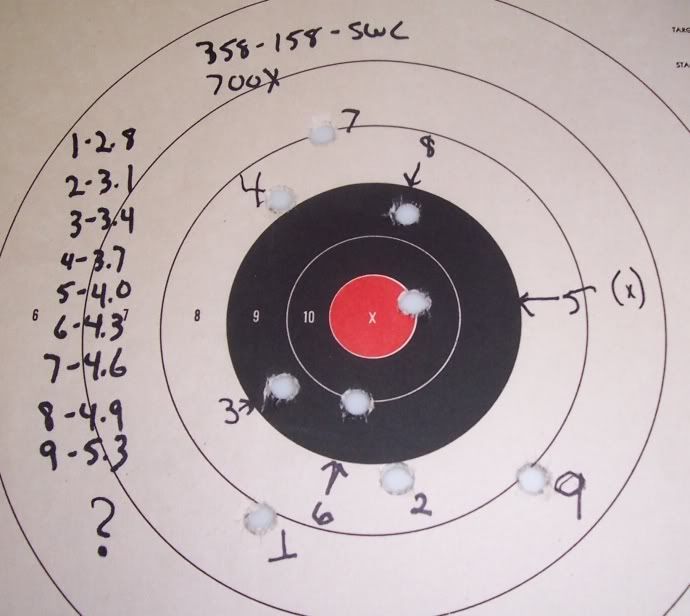
The final notes on Ladder Tests: Retesting ladders as follow up has proven to be critical. Consistency and accuracy with a revolver at 25 yards, even off sand bags, is hard to achieve. I wish I could say I redid the 700X Ladder for the Blackhawk, and this time it worked. But I didn't redo the Ladder. I had some 3.5 700X loads handy, with the 2 X Alox with Mica (Extreme Alox in prior post) lube and shot this great group:
Shot indoors, 25 yards off a sandbag rest, using the open iron sights on the Blackhawk.
This is a favorite load from the Taurus 66 and Rossi M92 rifle. 700X didn't shoot in the Blackhawk at all, at first.
In hindsight I suspect that the 700X Ladder missed this load because I flinched or made some other error. Maybe having worked out the lube & leading problem made the difference. So retest from time-to-time. Especially if you don't have much experience shooting off sand-bags or a rest.
Technique makes a big difference and it is all too easy too influence the Ladder Test results. This is true no matter what approach is used to work up loads.
Ladder Test - Incremental Load Develop continues to be my new favorite approach to work up accurate loads.
Luckily for me I had some 3.5 - 700X loads handy to shoot a few groups. It could be that a Ladder Test with fast powders should use .2 grain increments. The .3 increments I used in the other tests has a much great impact on 3.5 grains of 700X than it does on 13.5 grains of H110. Food for thought and a suggestion when you work up a load with a Ladder Test.
H110 in a Rossi Lever Action Carbine:
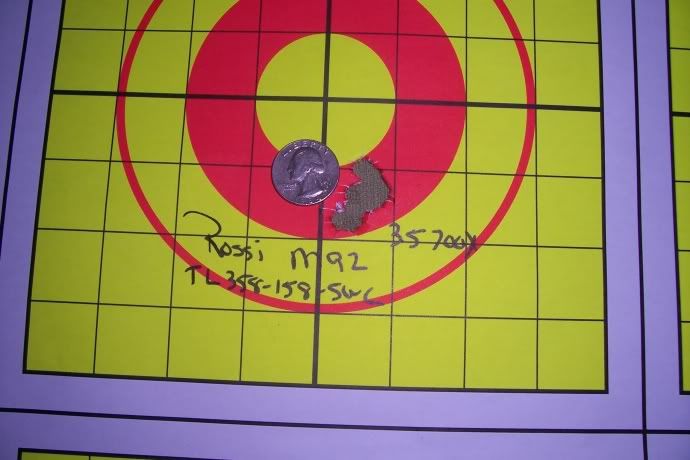
For fun I've included a picture of a 10 shot group from the 20 inch Rossi M92 Lever Action rifle. It's at 25 yards (max at my range) with the Lee TL-358-158-SWC (lapped) over 13.5 grains of H110:
A load of 13.5 grains of H110 with a magnum primer and either the Lee TL-358-158-SWC or the Keith 358-429 is a great performer. Fun to shoot in a revolver and fun to shoot in a rifle too.
Have fun refining your 357 Magnum handloads, the finest caliber of all.
Dedicated to pursuing accuracy with an the 357 Magnum Revolver and 357 Lever Rifle. The most accurate ammo possible is developed with the surprising results published right here.
Sunday, August 28, 2011
Sunday, August 21, 2011
Part 4: Using The Ladder Test - H110 Results, Also - Extreme Alox Defined
It's been a few weeks since starting this series. Here is a review of the H110 Ladder test. If you haven't been following along, please go to Part 1 and start there, otherwise this won't make sense.
First, the ladder test results using the Lee TL-358-158-SWC bullets, now dropping at 168-170 grains. I modified the mould by lapping it, which is described in a earlier post.
Based on this ladder, 13.5 grains is the sweet spot, now to test it out.
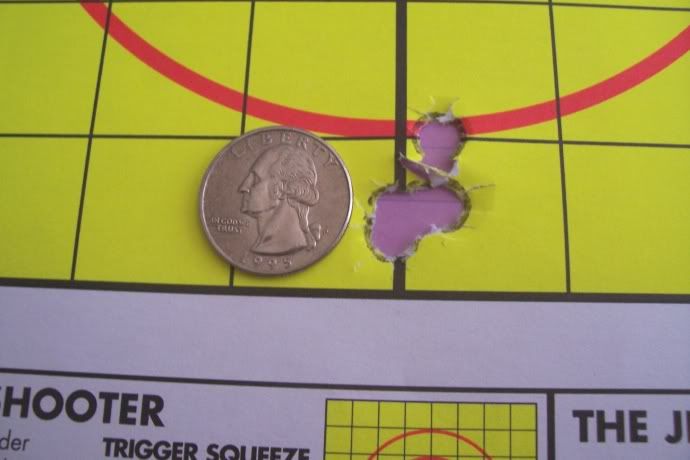
Testing the 13.5 grain load: The test revolver remains a Ruger 357 Blackhawk with a 6.5 inch barrel, and stock open iron sights. Shooting groups at 25 yards, even off a sandbag rest is a challenge for me. I included a quarter as a reference, the target sizes are completely different in these photos, with this one being 1/2 the size of the ladder test picture.
I've started shooting off-hand (unsupported) and more rounds in each group for these tests. This is one great result, for me, the variance is all shooter induced. The iron sights make it difficult to shoot every round in a tight group, but I seem to be improving. Even though it might not look like it to some of the readers.
The results of the tests have shown that the Ladder Test WORKS. At least in a longer barreled 357 magnum. I do plan a test with a 38 special snub-nose, but not as part of this series.
Refining the charge at the sweet spot is completely up to you, but I have yet to improve the cartridges accuracy beyond the test result. During this test, great loads using Unique and H110 were discovered for both bullets used. The Lee TL-358-158-SWC and the 358-429 from NOE, both are lapped. 700X was shown to not work in my Blackhawk (see Part 5 for more about 700X & fast powders in general), even though my Taurus 66 loved it.
Extreme Alox Described:
The Blackhawk shot the TL-358-158-SWC accurately from day 1. However it starts to lead at 10-20 rounds and looses accuracy at 40 rounds. At this point, the bullet isn't a viable option for this gun. The leading is right at the start of the lands, extending 1/8-1/4 inch.
I decided to see if it would ever shoot without leading this bullet, without fire-lapping the gun or modifying the gun in any way. I've gotten great results fire-lapping in the past, but it's not guaranteed to fix this problem, and once some metal is removed it can't be added back. So instead, I decided to test different way to lube with liquid Alox.
First, the Lee instructions for a standard application leave a very thin coating of Alox. This is the proven and standard way to lube using liquid Alox. Since that didn't work, I went non-standard, so this Extreme Alox (my term for the process) is to address a problem. If you have a similar leading problem, give either of the two approaches a try.
Extreme Alox 1: The Blackhawk has no leading in any load with the 358-158 any more. By applying a heavy coating of Alox and Mica, it shoots everything from puff loads to full magnum rounds leaving a shiny barrel after 100 rounds. The steps to apply this heavy coating are:
Dillon has dies designed to pop out for cleaning, then be put back, all without messing up the adjustments. They aren't cheap, but they are very well made and make cleaning a no-brainer.
Extreme Alox 2: Dipping the bullets into Alox also solved the leading problem. Alox applied using this technique is probably the most effective I've seen. That's the big plus, the negative is it's slow and takes patience. Rather than detail the how-to, here is a link with great instructions:
http://www.ranchdogoutdoors.com/Tips/Alox/
If your revolver is super accurate with a tumble lube design, but has a leading issue, it may need to be lapped to the correct size. In my case, the leading was minimal and the size wasn't an issue. So Extreme Alox solved the problem and continues to leave a shiny barrel.
That's a wrap for today.
Have fun and shoot tight groups!
First, the ladder test results using the Lee TL-358-158-SWC bullets, now dropping at 168-170 grains. I modified the mould by lapping it, which is described in a earlier post.
Based on this ladder, 13.5 grains is the sweet spot, now to test it out.
Testing the 13.5 grain load: The test revolver remains a Ruger 357 Blackhawk with a 6.5 inch barrel, and stock open iron sights. Shooting groups at 25 yards, even off a sandbag rest is a challenge for me. I included a quarter as a reference, the target sizes are completely different in these photos, with this one being 1/2 the size of the ladder test picture.
I've started shooting off-hand (unsupported) and more rounds in each group for these tests. This is one great result, for me, the variance is all shooter induced. The iron sights make it difficult to shoot every round in a tight group, but I seem to be improving. Even though it might not look like it to some of the readers.
The results of the tests have shown that the Ladder Test WORKS. At least in a longer barreled 357 magnum. I do plan a test with a 38 special snub-nose, but not as part of this series.
If you want to work up loads quickly and effectively use a Ladder Test. In one session, with as few as 5 rounds to 9 rounds, you can identify sweet spots with a given powder.
Refining the charge at the sweet spot is completely up to you, but I have yet to improve the cartridges accuracy beyond the test result. During this test, great loads using Unique and H110 were discovered for both bullets used. The Lee TL-358-158-SWC and the 358-429 from NOE, both are lapped. 700X was shown to not work in my Blackhawk (see Part 5 for more about 700X & fast powders in general), even though my Taurus 66 loved it.
Extreme Alox Described:
The Blackhawk shot the TL-358-158-SWC accurately from day 1. However it starts to lead at 10-20 rounds and looses accuracy at 40 rounds. At this point, the bullet isn't a viable option for this gun. The leading is right at the start of the lands, extending 1/8-1/4 inch.
I decided to see if it would ever shoot without leading this bullet, without fire-lapping the gun or modifying the gun in any way. I've gotten great results fire-lapping in the past, but it's not guaranteed to fix this problem, and once some metal is removed it can't be added back. So instead, I decided to test different way to lube with liquid Alox.
First, the Lee instructions for a standard application leave a very thin coating of Alox. This is the proven and standard way to lube using liquid Alox. Since that didn't work, I went non-standard, so this Extreme Alox (my term for the process) is to address a problem. If you have a similar leading problem, give either of the two approaches a try.
Extreme Alox 1: The Blackhawk has no leading in any load with the 358-158 any more. By applying a heavy coating of Alox and Mica, it shoots everything from puff loads to full magnum rounds leaving a shiny barrel after 100 rounds. The steps to apply this heavy coating are:
- Apply first coat of straight Alox, making a Z shape across the bullets, tumble, spread on wax paper and let dry overnight. This is a heavier coating than Lee recommends
- Apply the second coat of straight Alox, just like step1
- Apply a medium amount of Mica and shake around (see the tumble lube post)
Dillon has dies designed to pop out for cleaning, then be put back, all without messing up the adjustments. They aren't cheap, but they are very well made and make cleaning a no-brainer.
Extreme Alox 2: Dipping the bullets into Alox also solved the leading problem. Alox applied using this technique is probably the most effective I've seen. That's the big plus, the negative is it's slow and takes patience. Rather than detail the how-to, here is a link with great instructions:
http://www.ranchdogoutdoors.com/Tips/Alox/
If your revolver is super accurate with a tumble lube design, but has a leading issue, it may need to be lapped to the correct size. In my case, the leading was minimal and the size wasn't an issue. So Extreme Alox solved the problem and continues to leave a shiny barrel.
That's a wrap for today.
Have fun and shoot tight groups!
Saturday, August 13, 2011
Part 3: Using The Ladder Test - 700X Result, Keith and Unique Final Result
First the mould & bullet used in this Ladder Test: The 358-429 mould from NOE is lapped and now it drops 178 grain bullets. I round it to 180 and use those recipes. Since the actual bullet weight is lighter, it's safe. Working the other way can cause unsafe pressures, so don't use recipes for a lighter bullet.
A recap of Part 2 results: The 5.4 charge of Unique under the lapped TL-358-158 has proven to be extremely accurate. The leading problem reported in Part 2 has been completely solved. Look for an upcoming post "Extreme Alox" to see how. Ladder tests with a 357 revolver (a 6.5 inch Blackhawk in this case) is producing accurate loads. This continues to be a great surprise.
Now for the 180 grain Keith. For a description of the test approach please refer to Part 1 and Part 2.
This time there are 2 sweet spots. The pairing of shots 1 & 2 is the first, then 3 & 4 is the second. That suggest 5.1 grains of Unique and also 5.7 grains of Unique.
At this point, I know this bullet and the TL358-158 are the 2 most accurate moulds for a 357 magnum, and that the Ladder test produced a great load for the TL358. So I decided to shoot the 2 loads from this ladder off-hand, 25 yards with the open iron sights and unsupported in any way. I fully expect that off a rest they will group well, just like the TL358.
First the 5.1 charge of Unique. This is looks to me like another great load:
The 5.7 load is just a bit bigger, but still very respectable:
Not bad!
A review of the progress so far:
Coming up next, test results for H110 and the TL358-158. I plan to try all these loads out in the Rossi 20 inch M92 Lever action rifle. Oh, the Extreme Alox solution will be laid out in detail too. Without that, the single most accurate bullet would loose accuracy in 40 rounds. That would make it unusable.
But it is resolved, the Blackhawk and the TL358-158 are now an awesome combination. If you have similar problems with a bullet leading right at the start of the lands (rifling) maybe Extreme Alox will solve your problem.
At this point, the Ladder Test certainly work in a longer barrel 357. Give it a try to develop your most accurate loads.
A recap of Part 2 results: The 5.4 charge of Unique under the lapped TL-358-158 has proven to be extremely accurate. The leading problem reported in Part 2 has been completely solved. Look for an upcoming post "Extreme Alox" to see how. Ladder tests with a 357 revolver (a 6.5 inch Blackhawk in this case) is producing accurate loads. This continues to be a great surprise.
Now for the 180 grain Keith. For a description of the test approach please refer to Part 1 and Part 2.
This time there are 2 sweet spots. The pairing of shots 1 & 2 is the first, then 3 & 4 is the second. That suggest 5.1 grains of Unique and also 5.7 grains of Unique.
At this point, I know this bullet and the TL358-158 are the 2 most accurate moulds for a 357 magnum, and that the Ladder test produced a great load for the TL358. So I decided to shoot the 2 loads from this ladder off-hand, 25 yards with the open iron sights and unsupported in any way. I fully expect that off a rest they will group well, just like the TL358.
First the 5.1 charge of Unique. This is looks to me like another great load:
The 5.7 load is just a bit bigger, but still very respectable:
Not bad!
A review of the progress so far:
- 700X didn't produce a good ladder using the Blackhawk. Verfied later on, this combination isn't accurate. The 700X and the Taurus 66 357 is the most accurate combination, with that revolver. The variation of what works in one revolver vs another is quite large. So don't get frustrated is one of the "proven" recipes doesn't work in yours, try some other powders and you'll find one.
- The TL358-158 ladder with Unique produced a charge of 5.4 (1 sweet spot). It checked out to be incredibly accurate. Producing a best group, rested and iron sights, of .668 inches. That's awesome.
- The Keith ladder with Unique produced 2 charges (2 sweet spots). A charge of 5.1 and also a charge of 5.7. They are both excellent, with the 5.1 load having the slight edge. One off-hand test isn't conclusive in my book. But that is the result for this test.
- With the leading of the TL358-158 resolved, it just edges out the Keith for accuracy, making it the preferred bullet for 357 magnums.
Coming up next, test results for H110 and the TL358-158. I plan to try all these loads out in the Rossi 20 inch M92 Lever action rifle. Oh, the Extreme Alox solution will be laid out in detail too. Without that, the single most accurate bullet would loose accuracy in 40 rounds. That would make it unusable.
But it is resolved, the Blackhawk and the TL358-158 are now an awesome combination. If you have similar problems with a bullet leading right at the start of the lands (rifling) maybe Extreme Alox will solve your problem.
At this point, the Ladder Test certainly work in a longer barrel 357. Give it a try to develop your most accurate loads.
Sunday, August 7, 2011
Part 2: Using The Ladder Test - Lee TL358-158-SWC & 358-429 Keith with Unique and 700X
This installment covers the initial test results using the Ladder Test for a Ruger Blackhawk. A few key truths are made evident and discussed. I believe the results of this project translate to your 357 Magnum revolver and aren't only for my Ruger.
For the time being, ladder testing and validation using H110 moved onto the back burner. 700X and Unique early results are covered.
700X has proven to be one of the most accurate powders in the Taurus 66, and also the Rossi lever action rifle. The ladder test for the 358-158-SWC (tumble lube Lee mould, lapped and now dropping 168 grain bullets) going from 2.8 grains to 5.3 grains, in .3 grain increments:
The 700X ladder test for the 358-429 Keith (lapped and dropping 180 grain bullets) ranged from 3.1 to 4.6 grains:
The 358-168-SWC test results didn't look very conclusive to me, so I followed up with some accuracy testing to see what would those results would indicate. Wow, it wasn't pretty. Rather than posting picture of horrible groups, here is the bottom line:
The Ladder Test can in fact save time in determining that the gun-bullet-powder combination isn't effective, there was no clear sweet spot because this combination doesn't work. I think that's a big plus.
How about the results from the Keith ladder test? This test indicated a charge of 4.1 to 4.2 to be a sweet spot. After testing, it wasn't. There was no leading with this bullet, but it confirmed that the Blackhawk just doesn't like 700X. At least with 2 of the most proven bullets in other 357's.
Again, the ladder test proved to be helpful. It suggested a sweet spot that once tested, didn't work out. It saves time over testing 20 rounds, or more, at each charge weight (my old testing approach).
Before I would have loaded and test 20 rounds at each of the 6 charges, for a total of 120 rounds. Using the ladder test, I loaded 6 rounds and could have validated it with 20 more, for a total of 26. I did load and shoot more than that to see if the ladder test missed a sweet spot, it didn't. So far the ladder test is looking promising, even in a revolver and even at 25 yards.
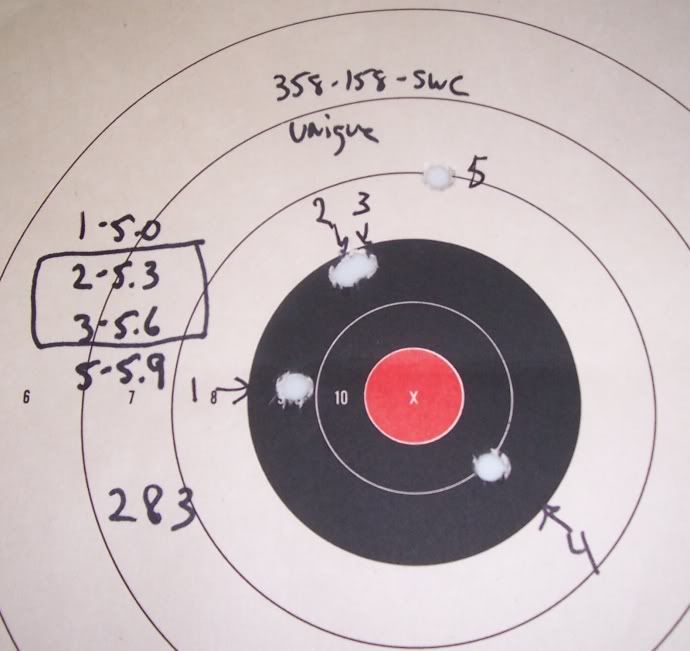
But can it find a validate sweet spot? Here is the Unique ladder test with charges from 5.0 to 5.9. Not a huge range, but I wanted to give it a try.
Now we are talking! The sweet spot is clearly between loads 2 & 3. Here is a group using 5.4 grains:
Please don't let my limited photographic skills mess up the effectiveness of these results. The ladder tests are on a big bullseye target. This test is on a target less than 1/2 the size. This group (excluding the shot I pulled) is a .668 group. Yeah, that's what I'm looking for! A sub 1 inch group, rested, at 25 yards using iron sights. That is a further indication that ladder testing (revolver, at 25 yards) WORKS.
I was able further validate, this is one sweet accurate load. BUT! This bullet still has the leading problem. That tells me it's not the powder as much as the bullet and the Blackhawk not working together. Testing with the H110 will either be strike three, or may work. It remains to be seen.
Conclusion: Early results of ladder test are positive. It saves reloading and range time by reducing the number of rounds needed to find a sweet spot. In my tests, the inconclusive results proved that there was not a sweet spot, another ladder result let me quickly determine that 700X didn't work with the Keith either. Then the third test produced a super accurate load, with a minimal number of rounds loaded and shot. That's very impressive.
This is extremely useful since bullet moulds and powders don't always translate from revolver to revolver, or if you need to work up a new bullet & powder combination for your revolver. Both 700X and the 358-158 that work so well well in other revolvers barely even group in the Blackhawk. Unique in the Blackhawk is working out very well, even though it didn't give the best results in the Taurus.
Shoot tight groups and enjoy your 357 Magnum. The most versatile and fun caliber to cast and handload, in my opinion of course.
For the time being, ladder testing and validation using H110 moved onto the back burner. 700X and Unique early results are covered.
700X has proven to be one of the most accurate powders in the Taurus 66, and also the Rossi lever action rifle. The ladder test for the 358-158-SWC (tumble lube Lee mould, lapped and now dropping 168 grain bullets) going from 2.8 grains to 5.3 grains, in .3 grain increments:
The 358-168-SWC test results didn't look very conclusive to me, so I followed up with some accuracy testing to see what would those results would indicate. Wow, it wasn't pretty. Rather than posting picture of horrible groups, here is the bottom line:
- The Blackhawk won't shoot this bullet accurately with 700X
- This bullet causes light leading near the forcing cone, with all charges. It wasn't horrible, but enough to affect accuracy after 50-60 rounds. Not acceptable
- The Blackhawk does not shoot either of the 2 best bullets well with 700X. Proof that bullet / powder combinations don't work equally well in every gun
The Ladder Test can in fact save time in determining that the gun-bullet-powder combination isn't effective, there was no clear sweet spot because this combination doesn't work. I think that's a big plus.
- A note regarding the leading: It was a small amount of leading, right were the lands start. The area between the cylinder throats and the lands is critical in a revolver. It's possible that the short 358-158 bullet allows gas to get around the bullet, in this critical area. Enough to cause this light leading, and the resulting loss in accuracy. Basically, a form of gas cutting. The leading occurred using Unique as well. With the longer Keith, there's no leading after 200 rounds. That's a big difference between the Taurus, that loves this bullet, and the Ruger.
How about the results from the Keith ladder test? This test indicated a charge of 4.1 to 4.2 to be a sweet spot. After testing, it wasn't. There was no leading with this bullet, but it confirmed that the Blackhawk just doesn't like 700X. At least with 2 of the most proven bullets in other 357's.
Again, the ladder test proved to be helpful. It suggested a sweet spot that once tested, didn't work out. It saves time over testing 20 rounds, or more, at each charge weight (my old testing approach).
Before I would have loaded and test 20 rounds at each of the 6 charges, for a total of 120 rounds. Using the ladder test, I loaded 6 rounds and could have validated it with 20 more, for a total of 26. I did load and shoot more than that to see if the ladder test missed a sweet spot, it didn't. So far the ladder test is looking promising, even in a revolver and even at 25 yards.
But can it find a validate sweet spot? Here is the Unique ladder test with charges from 5.0 to 5.9. Not a huge range, but I wanted to give it a try.
Now we are talking! The sweet spot is clearly between loads 2 & 3. Here is a group using 5.4 grains:
I was able further validate, this is one sweet accurate load. BUT! This bullet still has the leading problem. That tells me it's not the powder as much as the bullet and the Blackhawk not working together. Testing with the H110 will either be strike three, or may work. It remains to be seen.
Conclusion: Early results of ladder test are positive. It saves reloading and range time by reducing the number of rounds needed to find a sweet spot. In my tests, the inconclusive results proved that there was not a sweet spot, another ladder result let me quickly determine that 700X didn't work with the Keith either. Then the third test produced a super accurate load, with a minimal number of rounds loaded and shot. That's very impressive.
This is extremely useful since bullet moulds and powders don't always translate from revolver to revolver, or if you need to work up a new bullet & powder combination for your revolver. Both 700X and the 358-158 that work so well well in other revolvers barely even group in the Blackhawk. Unique in the Blackhawk is working out very well, even though it didn't give the best results in the Taurus.
- A .668 inch group is the best I've ever shot with iron sights. That's exciting!
Shoot tight groups and enjoy your 357 Magnum. The most versatile and fun caliber to cast and handload, in my opinion of course.
Sunday, July 24, 2011
Part 1: Using The Ladder Test - Incremental Load Development Method To Work Up Loads For A Ruger Blackhawk
This is part 1 of a multipart series. Over a period of weeks there will be follow-on posts with additional information.
In the past I enjoyed shooting the Taurus 66, putting thousands of cast hand-loaded rounds through it. Now I'm working out the same loads with a Ruger Blackhawk, 357 Magnum. It's an older three-screw, 6 1/2 inch barreled gem of a revolver. The plan is to rehash the best loads and see what works best in this new-to-me revolver.
We know the most accurate bullet designs, and have proven loads to work with. However I've decided to use a Ladder Test. This is a great way to quickly validate the best loads, and to also work out some new powder-bullet combination's. See the "Most Accurate Bullet Moulds and Loads Table" at the top of the right-hand column for a complete listing.
I'll start with the Lee TL358-158-SWC that has already been lapped. It drops full sized bullets with a .3604 diameter, that weigh 166 grains (I'll refer to them as 168's). They will be sized to .360 using a custom Lee push through sizer and lubed with Johnson's Paste Wax and Alox.
The plan is to use three powders. Two of them have demonstrated incredible accuracy.
Now that the stage is set, what the heck is the Ladder Test - Incremental Load Development Method. For a great read, click on that link. It will download a PDF article written by Randolph Constantine. It is a great explanation of this test approach, originally devised by Creighton Audette in the 1950's. It will frame the method using long range distances and rifles. The concept and approach is important for our purposes as I apply the Ladder Test to a iron sighted Blackhawk, indoors, at 25 yards.
Let's Get Started
Now the you have the concept behind the a ladder test, there are a couple of tools that make it much easier to handload one cartridge each of several different charges. Using a powder measure is possible but time-consuming and a just not-much-fun.
Borrow or purchase a powder trickler. They are easy and quick to use. The Lyman below is what I use, but all the major brands have good ones available (this cost $20 at Bass Pro Shops):
Use the trickler to feed the powder directly onto your scale. You can feed it quickly, or as slow as 1 speck of powder at a time. Great for weighing lot's of different loads.
Next is a funnel, to get that weighed charge into a sized, primed and flared 357 magnum case.
That's all it takes, assuming you have the scale and other reloading gear already.
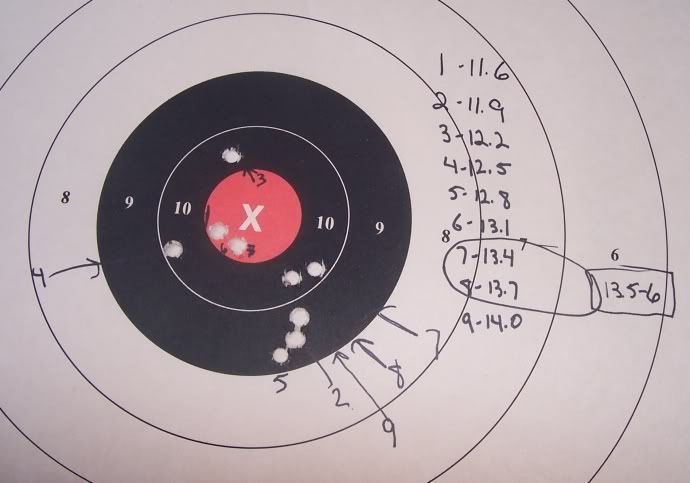
The Ladder that I worked up and loaded for this test is:
I used a few extra rounds to warm and foul the barrel. This target is the result; 25 yards from a rest and iron sights:
In the past I enjoyed shooting the Taurus 66, putting thousands of cast hand-loaded rounds through it. Now I'm working out the same loads with a Ruger Blackhawk, 357 Magnum. It's an older three-screw, 6 1/2 inch barreled gem of a revolver. The plan is to rehash the best loads and see what works best in this new-to-me revolver.
We know the most accurate bullet designs, and have proven loads to work with. However I've decided to use a Ladder Test. This is a great way to quickly validate the best loads, and to also work out some new powder-bullet combination's. See the "Most Accurate Bullet Moulds and Loads Table" at the top of the right-hand column for a complete listing.
I'll start with the Lee TL358-158-SWC that has already been lapped. It drops full sized bullets with a .3604 diameter, that weigh 166 grains (I'll refer to them as 168's). They will be sized to .360 using a custom Lee push through sizer and lubed with Johnson's Paste Wax and Alox.
The plan is to use three powders. Two of them have demonstrated incredible accuracy.
- 700X being a fast burn-rate powder
- H110 being the most accurate magnum powder tested to date, and I don't have a magnum load for this bullet, yet
- The last is Unique, it's a great powder that gets loaded more than any others, by more handloaders across the county than any others. It's generally accepted to be be the most flexible handgun powder since it's inception many years ago.
Now that the stage is set, what the heck is the Ladder Test - Incremental Load Development Method. For a great read, click on that link. It will download a PDF article written by Randolph Constantine. It is a great explanation of this test approach, originally devised by Creighton Audette in the 1950's. It will frame the method using long range distances and rifles. The concept and approach is important for our purposes as I apply the Ladder Test to a iron sighted Blackhawk, indoors, at 25 yards.
Let's Get Started
Now the you have the concept behind the a ladder test, there are a couple of tools that make it much easier to handload one cartridge each of several different charges. Using a powder measure is possible but time-consuming and a just not-much-fun.
Borrow or purchase a powder trickler. They are easy and quick to use. The Lyman below is what I use, but all the major brands have good ones available (this cost $20 at Bass Pro Shops):
Use the trickler to feed the powder directly onto your scale. You can feed it quickly, or as slow as 1 speck of powder at a time. Great for weighing lot's of different loads.
Next is a funnel, to get that weighed charge into a sized, primed and flared 357 magnum case.
That's all it takes, assuming you have the scale and other reloading gear already.
The Ladder that I worked up and loaded for this test is:
- TL358-158-SWC that is lapped and drops 168 grain bullets
- H110, this is really an attempt to work up a great load with combination because I don't have one for this bullet
- Charges in the ladder:
- 11.6 grains of H110
- 11.9
- 12.2
- 12.5
- 12.8
- 13.1
- 13.4
- 13.7
- 14.0
I used a few extra rounds to warm and foul the barrel. This target is the result; 25 yards from a rest and iron sights:
Revolvers (handguns in general) don't always walk up the ladder. Sometimes a heavier charge will shoot lower. In this case, that happened. Recalling the article on how to do this testing, look for 2 or more holes close together, with sequential numbers only. There's one set that shows the sweet spot, numbers 7 and 8. That puts a nice sweet spot at 13.5-6 grains, that should provide good groups.
I have an advantage at this point in working up the load. From prior test results (thousands of rounds) I know the diameter, OAL and that this bullet design has the capability to shoot sub-1-inch groups at 25 yards. That should decrease the time spent refining the load for maximum accuracy.
In Part 2, A range report using the load the Ladder Test produced. Also: How does the Blackhawk do? Ladder Test results using 700X and Unique will follow.
Have fun shooting, and keep the groups small.
Thursday, July 14, 2011
Some NOE 358-429 Moulds Available Right Now
I hate to sound like I'm pushing a product, however this is one of the best moulds you can buy for a 357 Magnum revolver. Or rifle. And you can't buy them but once a year, usually.
NOE is a small mould manufacturer and only does "runs" of moulds. It seems like they have some of these in stock. You will have to go to http://castboolits.gunloads.com/showthread.php?t=91999 and sign-up and let NOE (Swede Nelson) know you want one by posting and PMing.
I'm a very satisfied customer of NOE and promised to tell you how to get accuracy from your 357. This mould is 1 of the top 2 for accuracy. For a full-house magnum load, this is the best mould and bullet design. It does well downloaded too, but does it's best with a load of H110.
NOE is a small mould manufacturer and only does "runs" of moulds. It seems like they have some of these in stock. You will have to go to http://castboolits.gunloads.com/showthread.php?t=91999 and sign-up and let NOE (Swede Nelson) know you want one by posting and PMing.
I'm a very satisfied customer of NOE and promised to tell you how to get accuracy from your 357. This mould is 1 of the top 2 for accuracy. For a full-house magnum load, this is the best mould and bullet design. It does well downloaded too, but does it's best with a load of H110.
Sunday, July 3, 2011
Latest group from the Rossi 20" Carbine, 357 Magnum, Lee TL-358-158-SWC
Another update using my favorite load. One of the 2 best in a 357 Magnum Revolver & the 357 Magnum Carbine.
The lapped mould is dropping 166-167 grain full size bullets. Sized from .3604 to .360 with a custom Lee sizer, and lubed with 3/1 JPW/LLA (Lee Liquid Alox) or pure JPW (Johnson's Paste Wax) (the best lubes for this type of load). Loaded over 3.5 grains of 700X, and a long OAL of 1.610. They are shooting great in the rifle, and the revolver. These light loads, are low recoil. Yet in the revolver they can knock down a 100yard Ram at IHMSA Silhouette events.
To give you an idea of this from the Rossi at 25 yards, off-a-rest, 5 shot group, here is the dime-on picture:
Follow by the dime-off picture. The 5 rounds measure 0.28 inches center to center:
That was a fun day at the range! The approach to casting and handloading in the other posts produce this kind of a result. Hopefully the test results, forced ranking approach to accuracy, and the information in general helps your groups.
More about shooting the 357 Magnum Revolver with iron-sights, standing & off-hand. That is standing, with 2 hands and no supports. Once you have the most accurate load, this is one of the fun ways to enjoy yourself. I love red dots and scopes, but iron sights are simple and, like I said, FUN!
The lapped mould is dropping 166-167 grain full size bullets. Sized from .3604 to .360 with a custom Lee sizer, and lubed with 3/1 JPW/LLA (Lee Liquid Alox) or pure JPW (Johnson's Paste Wax) (the best lubes for this type of load). Loaded over 3.5 grains of 700X, and a long OAL of 1.610. They are shooting great in the rifle, and the revolver. These light loads, are low recoil. Yet in the revolver they can knock down a 100yard Ram at IHMSA Silhouette events.
To give you an idea of this from the Rossi at 25 yards, off-a-rest, 5 shot group, here is the dime-on picture:
Follow by the dime-off picture. The 5 rounds measure 0.28 inches center to center:
That was a fun day at the range! The approach to casting and handloading in the other posts produce this kind of a result. Hopefully the test results, forced ranking approach to accuracy, and the information in general helps your groups.
More about shooting the 357 Magnum Revolver with iron-sights, standing & off-hand. That is standing, with 2 hands and no supports. Once you have the most accurate load, this is one of the fun ways to enjoy yourself. I love red dots and scopes, but iron sights are simple and, like I said, FUN!
Wednesday, June 29, 2011
Update: The Best Way to Tumble Lube the Best Cast Bullets
Lube testing with 357 magnums has produced some fascinating results. This is an update on the prior lube posts.
For target loads with fast powder: The top 2 tumble lube variations of lube are JPW/Xlox mixed 3/1 and also pure JPW. They are so close in performance and accuracy that they are really equivalent. The JPW/Xlox (or LLA, it doesn't matter) gets the very slight nod because the best grouping I've ever shot used it. Also, after shooting many groups and taking all the measurements, the results are, on average, within .1 inch of each other. That's from 25 yards off a rest. This shooter isn't good enough to call that conclusive.
This is with the Lee TL358-158-SWC, lapped to drop 166-7 grain bullets. The most accurate design for a light-fast-powder load in a 357 magnum. (another test result is coming...)
Added later: I'm using up the Xlox/Alox that I have, using it to stretch my JPW. Once it's gone, I'll be using pure JPW again. I just hate to waste anything.
- Note: Tumble lubing standard groove bullets, for the light loads, may work well. However I haven't spent much time testing this combination. There is no leading, but accuracy may drop off. It would be slight, less than 1/4 inch at 25 yards. But that's speculation, since I haven't found a better more accurate bullet. I don't plan to test this more. Shooting less accurate bullet designs is not high on the list of ways to spend my time.
Heavy magnum loads using slow powder are most accurate with a heavy bullet. Using a 358-429 lapped mould, that drops 178 grain bullets has proven to be the most accurate. Using Darr lube has produced the best results with this combination. Other conventional lubes may work too, there are too many to test them all.
NOTE: Tumble lube on a large-groove bullet, with a magnum load, is proven to loose accuracy. This is not speculation. Up to 1/2 inch at 25 yards. Not that the TL fails to lube as there is no leading. I suspect the huge empty lube groove doesn't support the bullet base adequately. Causing the accuracy to drop off. That is with very soft bullets, so it may not apply to shooting WW or harder. Since the harder bullets have also proven to be less accurate, I won't spend time doing additional tests with them either.
Some general comments: That doesn't mean tumble lubing a with a small conventional-lube-groove will be less accurate. But it might, at longer distance. If you measure 25 yard groups with a caliper, and care about fractions of an inch in group size, it's worth testing.
If you shoot at 15 yards and do an eyeball, "looks good to me", you probably can't tell the difference so it doesn't matter.
The results in your gun, based upon lube groove design, lube, alloy, and charge should be similar to mine. Or said another way, a huge lube groove (like a Keith) with a soft bullet and TL may not be the most accurate combination, depending on the charge. So try it out, at some distance. When a tumble lube design proves to be extremely accurate, try some JPW/Xlox 3/1, or pure JPW.
I hope this is useful information that helps you shoot tighter groups with your 357 Magnum.
Sunday, June 26, 2011
Newly Added Hodgdon Load Data, and Benchrest Bags (Big Boy Bag)
Load data from Hodgdon continues to be the primary source of load data for my loading needs. The 357 Magnum Revolver and Rifle recipes are incredibly helpful, even though not every bullet weight has cast recipes. I admit to working up the jacketed recipes with cast. Work up the charges slowly, looking for pressure signs, keep the changes small and be safe! Before reaching the maximum charge accuracy often falls off, depending on the powder.
Hodgdon recipes are THE reliable source when loading Hodgdon powders. I do have several others manuals, but they always get checked with Hodgdon as a "failsafe".
Don't exceed the maximum charges, work up to them slowly and you'll get the most from the powder.
The most accurate loads are often light and well below any potential pressure problems, so they are not an issue. H110/W296 (they are the same powder) and Lil'Gun are the slow burners and high velocity powders. They do best at the upper end, so work up carefully and you'll be good. H110 has proven to be incredibly accurate, provides high velocity, and around here is easy to find. It's the only magnum powder in my powder cabinet.
The only thing I don't like about the Hodgdon charts is that the data isn't sorted by velocity. So below are 2 links, one for 357 Magnum Revolvers and one for 357 Magnum Rifles. Each is sorted within a bullet, by velocity. I've found this to be very helpful when deciding which powders to test. Its a small thing, but very helpful.
Also, the powders recommended by Hodgdon are what they have listed. You will notice many are missing from the Rifle data. That doesn't mean you can't use them. Just that Hodgdon believes they don't work as well in a rifle. You may not agree.
Load data sorted by Velocity for each Bullet:
357 Magnum Revolver Hodgdon's Recipes
357 Magnum Rifle Hodgdon's Recipes
Big Boy Benchrest Bags:
These posts are all about accuracy when casting, handloading and shooting 357 Magnums. My approach is to test a few loads at a time. The results are measured with calibers and force ranked, top down. The best performers are then tested against other "best performers". All at 25 yards off a rest. After many thousands of test rounds, my rolled up carpet "cheapo" rest is retired.
I've bought a few other rests, and didn't like them. After searching high and low, here it is. And wow! I love these bags. I filled them to be softer than pictured. They've been working out really well, so I though I'd pass along the info about the Big Boy, Flat Bags, and Rifle Stock Squeeze Bag. These aren't my guns, but are from the manufacturers website.
These bags a AWESOME! Fill them to meet your needs. Soft or more full for a firmer rest. Flip them, stack them, put them on their side, it all works. Did I mention how great these are. Look for your self:
Shoot tight groups, and have fun with your shooting. Oh, a great ballistics spreadsheet for the most accurate 357 Magnum loads is coming soon, stay tuned.
Hodgdon recipes are THE reliable source when loading Hodgdon powders. I do have several others manuals, but they always get checked with Hodgdon as a "failsafe".
Don't exceed the maximum charges, work up to them slowly and you'll get the most from the powder.
The most accurate loads are often light and well below any potential pressure problems, so they are not an issue. H110/W296 (they are the same powder) and Lil'Gun are the slow burners and high velocity powders. They do best at the upper end, so work up carefully and you'll be good. H110 has proven to be incredibly accurate, provides high velocity, and around here is easy to find. It's the only magnum powder in my powder cabinet.
The only thing I don't like about the Hodgdon charts is that the data isn't sorted by velocity. So below are 2 links, one for 357 Magnum Revolvers and one for 357 Magnum Rifles. Each is sorted within a bullet, by velocity. I've found this to be very helpful when deciding which powders to test. Its a small thing, but very helpful.
Also, the powders recommended by Hodgdon are what they have listed. You will notice many are missing from the Rifle data. That doesn't mean you can't use them. Just that Hodgdon believes they don't work as well in a rifle. You may not agree.
Load data sorted by Velocity for each Bullet:
357 Magnum Revolver Hodgdon's Recipes
357 Magnum Rifle Hodgdon's Recipes
Big Boy Benchrest Bags:
These posts are all about accuracy when casting, handloading and shooting 357 Magnums. My approach is to test a few loads at a time. The results are measured with calibers and force ranked, top down. The best performers are then tested against other "best performers". All at 25 yards off a rest. After many thousands of test rounds, my rolled up carpet "cheapo" rest is retired.
I've bought a few other rests, and didn't like them. After searching high and low, here it is. And wow! I love these bags. I filled them to be softer than pictured. They've been working out really well, so I though I'd pass along the info about the Big Boy, Flat Bags, and Rifle Stock Squeeze Bag. These aren't my guns, but are from the manufacturers website.
These bags a AWESOME! Fill them to meet your needs. Soft or more full for a firmer rest. Flip them, stack them, put them on their side, it all works. Did I mention how great these are. Look for your self:
Shoot tight groups, and have fun with your shooting. Oh, a great ballistics spreadsheet for the most accurate 357 Magnum loads is coming soon, stay tuned.
Sunday, June 19, 2011
For a Change of Pace: Good Group With My Rossi M92 Carbine Lever Action, 357 Magnum of Course, Part 2
Two great magnum loads for the M92, 357 magnum carbine have risen to the top of the accuracy chart.
First, the 2 moulds that are producing the most accurate bullets in the Rossi are also my 2 favorites for the revolver:
- 358-429 NOE, lapped
to drop .3604 bullets with BHN 7 alloy. New weight is 178-179 grains
(I'll call it 180, after the recipes that suite it best)
- TL358-158-SWC Lee, lapped to drop at .3604, also with BHN7 alloy. New weight is 168 grains
The NOE loaded over 13.5 grains of H110, with a heavy crimp, Darr lube, and a 1.620 OAL shot a 4 shot group of .33 inches. I estimate the velocity to be 1,400FPS. Measured center to center, 25 yards off a rest. Yeah I know, it's not much distance, but it's what's available to me.
This load just beat the Lee, lubed with JPW, over 3.5 grains of HP-38. The same 3.5 charge, but with 700X is right there as well. The HP-38 load shot a group of .34 inches.
With a slightly bigger grouping of .67 inches is the Lee, lubed with LLA/MS & Mica (detailed in the Tumble Lube post) over 15.5 grains of H110 and a heavy crimp. Wow, impressive round to shoot. I estimate the velocity of this load to be 1,700 FPS. The H110 works just a bit better with the 178 grain bullet. So I mention this because the 358-429 mould from NOE is only available during group buys, or used. The Lee is easy to get. If you can't get the a 358-429 that you can lap (steel and iron are tough to work on) the Lee 158, lapped, is a great option.
The other mould maker can listed on the right can custom make you a 358-429. Check them out.
It's worth noting that the lapped moulds are producing the most accurate ammo. For my 357's that is a bullet that drops from the mould at .3604 (roughly), and then sized for consistency to .360. The Keith works best sized and lubed on a lubrisizer. I like to size the Lee in a custom sizer (order directly from Lee for $35). Magnum loads get lubed with the LLA/MS and mica, while other loads get straight Johnson's Paste Wax.
A BRP 158 Hornady clone mould is here too. It's very high quality, an excellent mould. Preliminary results are looking great. I'm looking forward to working with it and will be reporting the results.
Sunday, June 5, 2011
For a Change of Pace: Good Group With My Rossi M92 Carbine Lever Action, 357 Magnum of Course, Part 1
Hi everyone,
I started this as a revolver blog, however from time-to-time I'll sneak in a post about my 3 month old Rossi M92, 357 magnum carbine. It's the round barrel, 20 inch version. The picture below is how it came from the factory. I added a Rossi weaver mount and a handgun-Simmons 4X scope. It was easy to do as Rossi does make the mount, and the rifle is pre-drilled below the stock sights to fit it:
I've been working on some loads for this sweet shooting rifle, and getting some good results. It's tough to say just how accurate at a longer range my loads would be, as I shoot almost exclusively at in indoor range. The limits distance to a short (for rifle) 25 yards.
So far, everything that shoots well in the 357 revolver shoots well in the rifle. But there are some loads that only work well in the Rossi. I'm definitely a rifle rookie and don't have a lot of high-end equipment such as a Ransom Rest, and when shooting groups use a rolled up carpet as my low-tech rest.
Anyway, here is a 5 shot group, the best by about .1 inch. The high shot was the first. The next 4 rounds went into the other hole. Center to center the 4 shot hole is .3 inches. THAT'S FUN! Even if it is 25 yards.
Oh, this is with a Lee TL158-SWC, BHN 7, .360 diameter, JPW lube, 357 brass and 3.5 grains of HP-38, OAL of 1.60 and medium crimp.
I enjoy casting and loading for the revolver, and now the rifle has added to the fun. 357 rifles are a blast to shoot, everyone needs one. Light 38 special loads just put a smile on my face. So do full-house H110 loads!
If you are thinking of a new rifle, one to have some fun with, take a look at this Rossi. If you do, check out Steve's Gunz (link on the right), his DVD is a must have.
Wednesday, May 25, 2011
Tumble Lube & Your 357 Magnum Revolver
Tumble lube works, and is a great way to lube your cast bullets. If you are new to tumble lubing, the basic process is published in the Lee Instructions. These directions are very good, short, to the point and cover the basic process. The two favorite approaches below are based upon these steps.
Tumble lube works on standard lube groove bullets, as well as on tumble-lube-bullets. Your should try these approaches to see how they work for you, and see which one your 357 revolver likes the most.
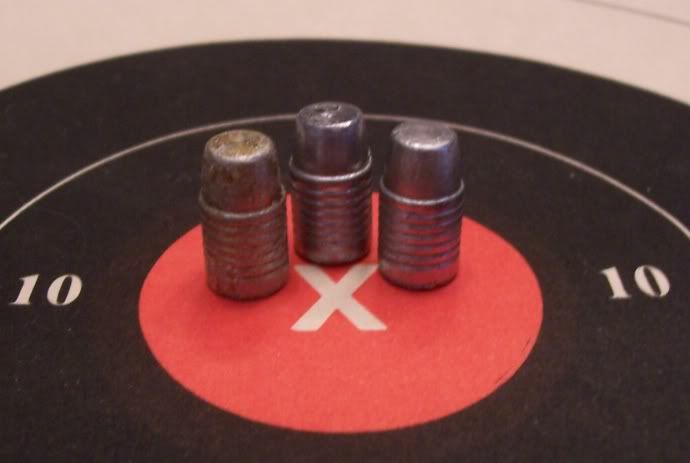
Here are three TL358-158-SWC bullets, one of the most accurate and best designed bullets that I've found. The first is lubed with Lee Liquid Alox (LLA) mixed with mineral spirits, followed by a dusting of mica. The middle bullet is a clean, sized bullet to act as a reference. The third is lubed with Johnson Paste Wax:
Approach 1
The mica can be bought from Midway, and probably other online sites too:
Approach 2
Johnson Paste Wax is becoming my favorite lube, it's awesome. However testing isn't complete, hot loads will be put through the paces soon. For lighter loads, the jury is in, it can't be beat in my opinion. It lubes great, is accurate, and less messy than traditional lube or liquid Alox.
Update: JPW works great with tumble lube design bullets. However it did fail to lube a 170 grain Keith bullet, resulting in leading. Keep that in mind when lube your bullets. I plan to shoot a lot more of it with light, very accurate loads. For full house Keith bullets I will continue to Lubrisize with Darr lube.
In Conclusion:
There are many other approaches that work too. However, these are the techniques I use most often these days and just may work well for you too.
One other very noteworthy approach was created by Recluse, a member of castboolits.gunloads.com. He created a mix called 45/45/10 that is hugely popular. It's 45% LLA, 45% reduced JPW and 10% mineral spirits. Search with Google and you'll be able to find it quickly. The detailed instructions are excellent and are available at that forum.
Shoot well!
There is a follow on post at: http://357shooter.blogspot.com/2011/06/update-best-way-to-lube-best-cast.html
Tumble lube works on standard lube groove bullets, as well as on tumble-lube-bullets. Your should try these approaches to see how they work for you, and see which one your 357 revolver likes the most.
Here are three TL358-158-SWC bullets, one of the most accurate and best designed bullets that I've found. The first is lubed with Lee Liquid Alox (LLA) mixed with mineral spirits, followed by a dusting of mica. The middle bullet is a clean, sized bullet to act as a reference. The third is lubed with Johnson Paste Wax:
- First: Prepare the bullets with WD40, lightly spray a bunch of bullets spread on a paper towel, and then run them through the sizer (don't let them dry before sizing). This avoids having to lube twice. It takes time for them to dry, which can be avoided and isn't needed. A penetrating oil/lube like WD40 isn't good for gunpowder, however the lube will coat it, and prevent any problems.
- Second: Prepare the lube, mix your Alox with Mineral Spirits, 2/1. This mix cuts the pure Alox or Xlox, making for a thin even application. Unless too much lube is used, it dries nicely, with very little stickiness.
- Third: Tumble lube per the Lee instructions, then spread on wax paper to dry. Use a small fan to help the lubed bullets dry more quickly, if one is handy.
- Fourth: Put the lubed bullets into another container, add a small (very small) amount of mica and swirl it around. Just like lubing.
The mica can be bought from Midway, and probably other online sites too:
Approach 2
Johnson Paste Wax is becoming my favorite lube, it's awesome. However testing isn't complete, hot loads will be put through the paces soon. For lighter loads, the jury is in, it can't be beat in my opinion. It lubes great, is accurate, and less messy than traditional lube or liquid Alox.
Update: JPW works great with tumble lube design bullets. However it did fail to lube a 170 grain Keith bullet, resulting in leading. Keep that in mind when lube your bullets. I plan to shoot a lot more of it with light, very accurate loads. For full house Keith bullets I will continue to Lubrisize with Darr lube.
- First: Prepare the bullets with WD40, lightly spray a bunch of bullets spread on a paper towel, and run them through the sizer (don't let them dry). This avoids having to lube twice, once before lubing. It takes time for them to dry, which can be avoided. A penetrating oil/lube like WD40 isn't good for gunpowder, however the lube will coat it, and prevent any problems.
- Second: Put the bullets into a plastic bag or container and let is sit for 5 minutes in hot tap water. This will warm the lead and will help the wax coat evenly. They should be slightly warm to the touch, not hot and not cool.
- Third: Scoop a small amount of the Johson's Paste Wax into a container of bullets. For 200 bullets, try a dime size glob of wax.
- Fourth: Tumble lube just like Approach 1, then spread on wax paper to dry. Use a small fan to help the lubed bullets dry more quickly, if one is handy.
In Conclusion:
There are many other approaches that work too. However, these are the techniques I use most often these days and just may work well for you too.
One other very noteworthy approach was created by Recluse, a member of castboolits.gunloads.com. He created a mix called 45/45/10 that is hugely popular. It's 45% LLA, 45% reduced JPW and 10% mineral spirits. Search with Google and you'll be able to find it quickly. The detailed instructions are excellent and are available at that forum.
Shoot well!
There is a follow on post at: http://357shooter.blogspot.com/2011/06/update-best-way-to-lube-best-cast.html
Sunday, May 15, 2011
Notes: Lee TL358-158-SWC Lapped for Testing, 700X & Variation / Issues, RCBS 38-150SWC Mention
A Lee TL358-158-SWC 6 cavity mould arrived the other day. After buying & selling many moulds, I wanted to revisit this fine design, looking to refine the tumble lube process. Wow, this new mould dropped very small bullets. The .357 to .358 bullets are not what I expect.
Time to lap another mould. To get each cavity to over .360 took a little longer. Lapping it slowly and taking measurements often, now it's dropping these fully sized bullets. Oh, this mould is casting great at 800-850 degrees. I think the tumble lube grooves fill out easier then the grooves on a 358-429 mould. The lack of deep squared off Keith grooves makes a difference:
They now weigh in at 163 grains when using 98% lead and 2% solder. This newly-lapped mould has improved accuracy compared to the unlapped-one used originally. When enough testing is complete the charts will get updated.
Early results using 5.3 grains of Unique look promising. If it proves to be consistently accurate it will get added to the most accurate chart.
Now, info on 700X: After loading many pounds of this powder, it finally has/had accuracy issues. Just recently, 2 different canisters proved to vary quite a bit. More than bumping the charge up or down 2-3 tenths of a grain. Powders can vary 10% and still be in tolerance, but if you run into unexpected results, it could a bigger variation of the powder than usual. There was no safety problem or concern, however groups opened up to the point of being horrible and at any charge - inaccurate.
I still have a 3 cannisters and will verify the third unopened cannister in the next few weeks. In the mean time, further test will be with HP-38, H110 and Unique. The first 2 are proven accuracy producers. Unique is now at the top of the accurate powder poll. In the past, it shot well, but wasn't one of the best. I added it to the mix to revisit and see how it does.
As always, the results based on caliper-measured-groups will determine if it really does deserve to be on the Most Accurate Bullet Moulds and Loads Table.
In closing this update: Recently tests using the RCBS 38-150-SWC have shown it's a good shooter. But so far not consistent enough to make the list. It may work well in your revolver, but until it proves itself in my Taurus 66 it gets "try it if you'd like" mention, off-list.
Sunday, May 1, 2011
Lapping a Mould: What to do if your mould is dropping small bullets
We've all had a mould that dropped small bullets. It's expensive to send it out for machining, and the manufacturer may fix it how you want, but in many cases is a hit or miss proposition.
You can fix it with a few tools. Carefully follow these steps and you can improve the bullets that you cast and shoot. This translates to tighter and more consistent group sizes at the range.
First, here are a few 358-429 Keith's cast with a lapped aluminum mould, they are already sized and lubed:
There's various ways to lap a mould. This is one technique that works well and is proven. This 358-429 mould is aluminum with 5 cavities. The number of cavities doesn't matter, however other materials take longer and are more difficult to lap.
The process, step-by-step:
1) Get some nuts, for 357 I use 1/2 inch, one per cavity
2) Heat the mould to casting temp
3) Open the sprue plate and rest a nut over each cavity
2) Heat the mould to casting temp
3) Open the sprue plate and rest a nut over each cavity
4) Cast through each nut, overfilling by a little bit. If it runs a bunch,that's OK (if not full enough the nut may spin on the lead)
5) Drop'em out as usual, and let it all cool
6) Lightly coat the bullet with compound (note below)
The bullets in the picture below have already been used to lap.
7) Put each bullet back into the cavity it came from (twist off the lead if it keeps a wrench or socket from fitting the nut)
8) Either with a wrench or with a electric drill/socket start slowly lapping, while applying pressure on the handles. Use a c-clamp (if handy) to tighten down the cavity being lapped, adding pressure slowly. Lap each cavity for 1 minute (longer if by hand) per lapping session, and vary the speed and reverse direction if possible. Keep it slow and you'll be good
9) Clean it up and go-to step 1
That's the process. Use the cast bullets to actually do the lapping, in the same cavity they were cast in. Measure each newly cast nut-bullet at a couple of points, like on the seam and then across the seam. Lap each cavity enough times to get the size you want, or just to polish it. I lapped mine 3 times with 600 grit compound and 1 time with Rubbing Compound.
The lapping compound can be something like Wheeler 600 grit, auto rubbing compound (used this for the final-lap or polishing as it is very fine) or even toothpaste for polishing only. Valve compound works too.
Because I use a lubrisizer, I wanted to get the minimum measurement to .0004 over my final size. So with a .360 size as the goal, the minimum I wanted is .3604. If you don't size your bullets, just stop when each cavity is at the right size.
Benefits of a lapped mould:
- The bullets just fall out of a lapped mould.
- Sizing & lubing is easier as lube doesn't shoot-the-gaps and flood the die.
- The best result is having fully sized bullets and not only shooting smaller groups but shooting them more consistently too
Lapping a mould is messy, so between sessions wash the mould at a sink with Dawn or something similar. For a 5 cavity mould it takes 15-20 minutes for 2 lapping sessions. So it doesn't take long. Go slow and keep the stress down.
Good shooting!
Sunday, April 17, 2011
Annealing Lead Alloy for Softer Boolits - Final Hardness Results
To the new folks, there is a description of the Annealing test in the 2 prior posts. To the regulars, welcome back for another visit. Now, to the test results:
The hardness continues to increase, at a rate much like air cooled WW alloy. After 14 days it's up to 12.5 BHN. Annealing works incredibly well, for a week or two. That's something to keep and mind and will aid you in making use of this information in the future.
For an afternoon plinking, it's probably not worth the effort. For an event, or for a test day at the range, it can make a huge difference.
Freezing the annealed bullets is a way to keep them soft for a longer period of time. Testing the effectiveness of freezing is in the plans, so stay tuned for more analytics, charts and results.
The hardness continues to increase, at a rate much like air cooled WW alloy. After 14 days it's up to 12.5 BHN. Annealing works incredibly well, for a week or two. That's something to keep and mind and will aid you in making use of this information in the future.
For an afternoon plinking, it's probably not worth the effort. For an event, or for a test day at the range, it can make a huge difference.
Freezing the annealed bullets is a way to keep them soft for a longer period of time. Testing the effectiveness of freezing is in the plans, so stay tuned for more analytics, charts and results.
Sunday, April 10, 2011
Annealing Lead Alloy for Softer Boolits - First Results
For background on this test, please read the prior post.
The cast bullets used in this test were annealed for 30 minutes at 450 degrees. The oven was turned off, with the bullets inside, until cooled.
Here is the data in chart format, click on the chart to see it full size:
This particular air cooled wheel weight alloy tested as 10.4 BHN, the day after casting. A bit hard, but in the range of modern day wheel weights. After six weeks and just prior to annealing they tested at 14.2. Immediately after cooling they dropped to 8.2. That's a pretty big drop in hardness. After 7 days they age harden back to the 10.4 as-cast hardness.
I plan to test them again next week to verify just how they continue to harden.
It's a nice surprise that the hardness dropped to 8.2, just what I had hoped for. As you can tell, they don't stay there long. If you cast & load with a just in time approach, this can be very helpful. If you cast thousands of bullets to be loaded over the next year, you can still anneal in smaller batches, as needed.
It's encouraging to know that the wheel weights can be softened. The consistency and accuracy achieved in a 357 Magnum with softer lead is measurable and noticeable.
I plan to roll this new-found-knowledge into my current casting-handloading-shooting schedule. Currently I cast 5-10 lbs of a given bullet, let them age for 2 weeks, lube & size them. At that point they are ready to load then shoot. Usually lasting for 2-4 weeks. That's with 2 different bullet designs going, shooting 200-250 total rounds a week it works. Now I'll anneal-lube-size a week in advance for bullets that need to be a softened up.
Hope this helps and gets you to 1 ragged hole at 25 yards.
Monday, April 4, 2011
Annealing Lead Alloy for Softer Boolits - The Approach
Since my supplier of pure lead is drying, the problem is how get bullets of BHN 8 or less casting with wheel weights. Softer lead bullets provide consistent accuracy, as compared to BHN 11, or 16 or harder. A well designed bullet, sized to perform in your revolver (often .360 works, but some revolvers vary) can produce great groups, even if it's a harder than BHN 8. However, softer alloys produce better groups, and do it more consistently.
Strange as it sounds, the process to soften wheel weight alloy bullets is much like the process to harden them. The difference is, to soften the bullets, they don't get quenched in cold water.
The goal of the upcoming test, is to verify that bullets can be softened to BHN 8, or as close to it as possible. If they can be softened, does it last more than a few days or does it last for weeks. Since it takes a long time to verify test results, it will be about a month before I can post the resulting data.
Strange as it sounds, the process to soften wheel weight alloy bullets is much like the process to harden them. The difference is, to soften the bullets, they don't get quenched in cold water.
The goal of the upcoming test, is to verify that bullets can be softened to BHN 8, or as close to it as possible. If they can be softened, does it last more than a few days or does it last for weeks. Since it takes a long time to verify test results, it will be about a month before I can post the resulting data.
The process is to heat the bullets in the oven, then turn it off and let them cool to room temp. It can take a couple of hours to cool slowly.
The initial results will be for pure wheel weights, additional tests will verify the impact of adding additional tin. Which is reported to soften the bullets even more. Pretty great if it all works out.
The planned test will:
1) Heat bullets in the oven, set to 450 degrees, for 30 min
2) Turn it off, let the entire oven with bullets inside cool to room temp
3) Test the bullets hardness before heating, after heating and then at 7 day intervals
4) Report the results here
To achieve the best accuracy, shooting a softer alloy makes all the difference. That is, in 357 magnums of course. Not that I'm closed minded, but it is the most fun caliber to cast, handload and shoot, bar none.
Saturday, March 26, 2011
Lyman 358-477 : 150 grain SWC: Accuracy Results
Accurate results with the lighter bullets has been impossible, so far. Today with a medium crimp and loaded over 3.5 grains of 700X, success! A very accurate sub-1-inch 5 shot group of .69. That makes the 358-477 one of the best moulds for the 357 Magnum revolver. The actual bullet looks different than Lyman's website:
As always, that's with a Taurus 66, 6 inch barrel, from at rest at 25 yards. The Taurus is now carrying a Simmons 4X scope which is very effective. Here's a picture, the 358-477 group is the first target:
The updated details of the load are in the Most Accurate Bullet Moulds and Loads Table
Additional tests are planned to further refine the OAL, which is very important for this bullet. I will be testing magnum powder charges in the future, but the initial results are not worth mentioning so far. That may change, and the results will speak for themselves.
The 358-477 works great loaded long, tested with a OAL of 1.620 (a little shorter may work) and lubed with Darr lube.
FYI: NRA lube is quickly becoming my favorite, and works well with all 357 bullets, including this one. The high quality and the low price of the hollow sticks from White Label Bullet Lube make it a great value. NRA has been a favorite for cast bullet shooters for years, and with good reason.
The 358-477 is super accurate, with light recoil and very economical to shoot. The Lyman steel/lead moulds cast great and won't break the bank. Available new in 2 cavity and 4 cavity versions and available from all the web-sites that sell resloading / casting equipment. Midsouth has the best price right now, at least that I can find.
As always, that's with a Taurus 66, 6 inch barrel, from at rest at 25 yards. The Taurus is now carrying a Simmons 4X scope which is very effective. Here's a picture, the 358-477 group is the first target:
The updated details of the load are in the Most Accurate Bullet Moulds and Loads Table
Additional tests are planned to further refine the OAL, which is very important for this bullet. I will be testing magnum powder charges in the future, but the initial results are not worth mentioning so far. That may change, and the results will speak for themselves.
The 358-477 works great loaded long, tested with a OAL of 1.620 (a little shorter may work) and lubed with Darr lube.
FYI: NRA lube is quickly becoming my favorite, and works well with all 357 bullets, including this one. The high quality and the low price of the hollow sticks from White Label Bullet Lube make it a great value. NRA has been a favorite for cast bullet shooters for years, and with good reason.
The 358-477 is super accurate, with light recoil and very economical to shoot. The Lyman steel/lead moulds cast great and won't break the bank. Available new in 2 cavity and 4 cavity versions and available from all the web-sites that sell resloading / casting equipment. Midsouth has the best price right now, at least that I can find.
Sunday, March 20, 2011
357 Magnum Cast Bullet Crimping
A short note on the roll crimp used for cast bullets: Nothing in casting and handloading works for everyone, for all guns, for all reloading presses and in all instances. Crimping is just like that. You will have to adjust a bit, but crimping does affect accuracy and is important.
I do know the Lee crimping dies and the Dillon Square Deal B dies do work with these adjustment specs (note: the Lee FCD can cause problems. For accurate cast bullets that are oversize at .360 diameter, a regular roll crimp die works best.):
The 700X and HP38 loads in the Most Accurate Boolits and Loads Chart have a medium crimp. The 700X 5.1 load and all the H110 & 2400 magnum loads have a heavy crimp.
What does this mean? First, here's how I zero the crimp:
Bullet diameter plays an important factor with the crimp setting. Recently, with full size .360 diameter bullets, and using a Lee seating/crimp die, a light crimp proved to work the best.
The 148 wadcutters also work well with a medium crimp. I've not been able to produce good results with a light crimp on a wadcutter as many recipes or tips advise. It's worth a try if you are shooting a full wadcutter. Like the opening said; nothing in casting and handloading works all the time.
I do know the Lee crimping dies and the Dillon Square Deal B dies do work with these adjustment specs (note: the Lee FCD can cause problems. For accurate cast bullets that are oversize at .360 diameter, a regular roll crimp die works best.):
Crimping cast boolits without a groove, or crimping on the driving band: This takes pure experimentation. The Lyman 358-429 crimped onto the front band works well with a light roll crimp. It's important to crimp enough so the bullets don't jump out of the case due to recoil, and not to much crimp or it will ruin accuracy.
The 700X and HP38 loads in the Most Accurate Boolits and Loads Chart have a medium crimp. The 700X 5.1 load and all the H110 & 2400 magnum loads have a heavy crimp.
What does this mean? First, here's how I zero the crimp:
- Back out the crimp die
- Size a fires 357 magnum case
- Place the case under the crimp die and raise the ram (don't use a flared case)
- There should be no contact between the crimp die and the mouth of the case
- Holding the ram up, Screw in the crimp die until it make firm contact
- Now the crimp is zeroed
- Light crimp = 1/2 additional turn of the crimp die from zero
- Medium crimp = 3/4 additional turn of the crimp die from zero
- Heavy crimp = 1 additional turn of the crimp die from zero
Bullet diameter plays an important factor with the crimp setting. Recently, with full size .360 diameter bullets, and using a Lee seating/crimp die, a light crimp proved to work the best.
The 148 wadcutters also work well with a medium crimp. I've not been able to produce good results with a light crimp on a wadcutter as many recipes or tips advise. It's worth a try if you are shooting a full wadcutter. Like the opening said; nothing in casting and handloading works all the time.
Wednesday, March 9, 2011
Initial test results: Casting at 725 VS 925 degrees. How bad is casting hot????
So this topic has been bothering be for some time. I've often heard concerns of what happens to WW and other bullet alloy when casting with a hot pot. So it was time to run a test. I also wanted to figure out how to soften WW to meet my needs in my 357 magnums.
I figured I'd cast test bullets at intervals (see below) and measure the BHN after 1 day, 7 days and 14 days. After 1 day I'm shocked enough to post the first results.
The test scenario is straightforward:
The 725 degree test and then the 925 degree test are identical:
There is no negative impact on BHN from casting with a hot pot.
My goal of wanting to cook WW down to a softer BHN isn't going to work out. I'll wait a week and see if results change at all. But I didn't expect them to be 10.4 this quickly and don't foresee them getting much harder, if at all.
The next time someone tells you the horrors of casting with a hot pot and the major impact of oxidizing tin etc... and having a major negative impact on the bullets, you don't have to take their word for it. You don't have to take my work for it either. The test is easy, try it yourself and see what your results are.
I plan to continue casting hot as I find it to work well. Now that I know for a fact there's no negative impact on the alloy, there's no reason to be concerned at all.
Update: Here is a snippet from the Lyman Cast Bullet Handbook, third edition, page 43. The tin and antimony doesn't cook out of the lead. It's apparently difficult to remove enough tin / antimony to matter. Cooking 2 hours at 925 oxidized out some tin possibly, but it still measured 10.4 BHN, it made ZERO difference.
Added for clarification: There is a popular idea that casting with a hot pot cooks out the tin and antimony from the WW alloy. If that happened the alloy would be softer. Their follow on argument is that a hot pot oxidizes out the tin and antimony, some cliam within minutes. Again, if either point is true, the alloy will become softer.
Added: How to harden and soften cast bullets using heat is an upcoming topic. However a few other projects are first. A much closer look at H110 in the 357 Magnum is not-to-far-off.
I figured I'd cast test bullets at intervals (see below) and measure the BHN after 1 day, 7 days and 14 days. After 1 day I'm shocked enough to post the first results.
The test scenario is straightforward:
The 725 degree test and then the 925 degree test are identical:
- Clean out the pot
- Put in 3 lbs of WW
- Bring the lead to 725 or 925
- Cast 4 bullets - minute 0 of the test
- Cast 4 bullets - at the 30 minute mark
- Cast 4 bullets - at the 60 minute mark
- Cast 4 bullets - at the 120 minute mark
725 BHN results after 1 day:
0 min = 10.4
30 min = 10.4
60 min = 10.4
120 min = 10.4
925 BHN results after 1 day:
0 min = 10.4
30 min = 10.4
60 min = 10.4
120 min = 10.4
There is no negative impact on BHN from casting with a hot pot.
My goal of wanting to cook WW down to a softer BHN isn't going to work out. I'll wait a week and see if results change at all. But I didn't expect them to be 10.4 this quickly and don't foresee them getting much harder, if at all.
The next time someone tells you the horrors of casting with a hot pot and the major impact of oxidizing tin etc... and having a major negative impact on the bullets, you don't have to take their word for it. You don't have to take my work for it either. The test is easy, try it yourself and see what your results are.
I plan to continue casting hot as I find it to work well. Now that I know for a fact there's no negative impact on the alloy, there's no reason to be concerned at all.
Update: Here is a snippet from the Lyman Cast Bullet Handbook, third edition, page 43. The tin and antimony doesn't cook out of the lead. It's apparently difficult to remove enough tin / antimony to matter. Cooking 2 hours at 925 oxidized out some tin possibly, but it still measured 10.4 BHN, it made ZERO difference.
Saturday, March 5, 2011
Accuracy Results: Lyman 357-446 & Lyman 358-429
The older Lyman 357-446 mould is found on eBay and other web auction sites these days. They is an great buy. Test results at 25 yards are excellent with the potential of groups less than 1 inch. The best group being .78 inches.
The Lyman 358-429 is available new from any of the online shooting supply sites. Midsouthshootersupply.com has the best prices right now, that is always subject to change.
UPDATE on 3/19/11: The Lyman 358-429 seated at 1.620, crimped into the front driving band works great. It shot a best group of .8 inch over 11.8 grains of H110 at the range today. That was out of 3 groups of 5. It liked a light crimp, but more testing is needed to confirm the bullets don't pull out a bit under heavy recoil. I'll add it to the next version of the Accuracy Chart.
UPDATE on 4/23/11: Note, I ran across a few Lyman moulds that drop undersized bullets. This can really impact accuracy. Just a warning to measure the bullets, and have Lyman fix any problems that exist.
The Lyman 358-429 is available new from any of the online shooting supply sites. Midsouthshootersupply.com has the best prices right now, that is always subject to change.
If you are a new reader, all tests are conducted at 25 yards, off a rest. This time a Simmons scope has replaced the Red Dot. With a 1 inch "dot" in the Red Dot, it makes testing difficult. Hiding 1 inch is a bunch when attempting to shoot 1 inch and smaller groups. I'm still getting used to the Simmons, but like it quite a bit. Oh, its a 4X power scope too, works out great at 15 yards too.
The 357-446 is an older discontinued design and has some controversy surrounding it. You decide if it matters to you, it doesn't to me and I plan to keep it. Some reports claim this bullet starts having flyers at 50 yards, and the problem gets worse at 100 yards. Specifically at 38 special velocities, which the super accurate load below is. This is a good shooting and good looking bullet design.
If you shoot at very long distances at 38 special velocities it may make a difference to you. If not, this is a great mould that is readily available on eBay, and other auction sites.
This is now ranked fourth on the Most Accurate Boolits and Loads chart:
| Rank | Mould | Weight | Group | Charge | OAL | Velocity |
| 1 | 360-200-SWC | 200 | 0.57 | 3.4, 700X | 1.614 | 660 |
| 2 | 358-429 NOE | 168 | 0.58 | 4.7, HP-38 | 1.620 | 900 |
| 2 | 358-429 NOE | 168 | 0.58 | 5.1, 700X | 1.620 | 1,200 |
| 3 | 158-SWC TL | 158 | 0.61 | 3.5, HP-38 | 1.600 | 810 |
| 4 | 357-446 | 162 | 0.78 | 3.5, 700X | Groove | 890 |
| 5 | 358-429 NOE | 168 | 1.00 | 11.8, H110 | 1.620 | 1,260 |
| 6 | 158-SWC TL | 158 | 1.10 | 5.1 HP-38 | 1.600 | 1,129 |
| 6 | 148-WC TL | 148 | 1.10 | 3.5 HP-38 | 1.400 | 928 |
| 7 | 360-200-SWC | 200 | 1.18 | 3.0, 700X | 1.614 | 660 |
| 8 | 360-145-SWC | 145 | 1.20 | 3.9 700X | Groove | 1,020 |
| 9 | 358-429 NOE | 168 | 1.30 | 10.3,2400 | 1.620 | 910 |
| 10 | 140-FN-LBT | 140 | 1.40 | 5.8 700X | Groove | 1,347 |
The alloy used id the proven soft mix or lead/solder at 50/1 .
The Tarus 66 has a .357 groove diameter with .358 cylinder throat sizes. This is optimum, not all guns are this cast-boolit friendly. That means they produce bigger groups. I'll stick with the Taurus and the small groups.
Subscribe to:
Posts (Atom)