Friday, February 24, 2012

Group Buy Update - 357 Lever Action Testing - New Blog Format Coming

My shooting range is closed for renovations, which means testing and development time has been scarce.  Don't worry, there are some good projects underway.  First, here's another look at the the Custom Lee 358429 Group Buy Bullet:


The sign-up phase runs out at 5pm on Saturday, 2/25.  It's a sweet bullet, designed like the Lyman long nose version.  Check out the link on the right for more info.

357 Lever Action Tests & Results Coming Soon:

OK, I've been enjoying the heck out of a Rossi 357, 20 inch, carbine.  The goal is to explore higher velocity loads.  There are some very accurate loads already in my results-database.  I'm changing gears a bit and will pursue pushing some 110 and 158 grain cast bullets.  These very strong guns respond well to pushing things a bit. 

Pushing a 110 grain cast bulllet over 2,000 FPS is on the test agenda.

A new Rossi is on the way, if you haven't cast/loaded/shot one of these, see if you can get your hands on one.  There are some tips to smooth them out a bit, that will be covered too.


These will not be revolver loads, they are intended only for modern day, very strong, rifles.  The M92 Rossi is one of them, and will be used for the load development.

I'm really looking forward to ringing this out!  Here's a preview of a 110 grain bullet still on the drawing board:


There's more where that came from!

A Table of Contents is Coming Soon:

It's reached a point that the usual Blog format is getting hard for readers to navigate around.  A Table of Contents to make it easier to find a particular topic and post is in the works.  This will be a big help in seperating the Revolver & Rifle specific topics.

That is somewhat less exciting than a 2,000 FPS load, but worthy enough to mention.

Stay tuned, the range will be opening soon and more results are one the way.

Saturday, February 18, 2012

Sign-up Phase in Final Week: Group Buy for a Custom Lee Mould. The 358-429 Keith

UPDATE: The group buy is going very well.  There are 8 people signed up as I'm typing this.  I'm making a change to the minimum number needed, to 7.  That means the buy will happen.

I've decided to start a Blog based group buy for a custom Lee six cavity mould.  I'm so impressed with the results from my mould that I thought this would be both fun and a chance for other 357 casters / handloaders to take advantage of this style mould.   There aren't many places to get a Keith six cavity mould, as a matter of fact a custom mould is the only way I know of.


There's a Blog Page that describes the planned group buy.  It's a slightly different protocol than other group buys so please read through it.  The link at the top of the right hand column will take you to the details.


Comments, feedback and questions should be posted there as well.


Here are some results, rested at 25 yards:


A little reminder of how they look:


As always, have fun and shoot tight groups.

Saturday, January 21, 2012

Update on the New - Custom Lee 358-429 & Bullet Fit Tips

Getting a new-to-me Taurus 669 at the same time as the new mould came in created a double learning curve.  It's what I love to do, but it takes some time to develop great loads.  Finally, here's more detail about my target load and some early results from a full magnum load.

This Lyman styled six cavity mould is cut to my specs and drops soft alloy bullets over .360 inches.  Just as I wanted.

The Taurus has a conventional groove diameter of .357.  It's throats are huge, at .3595 and .360.  It's a good thing that mould drops some fat bullets! 

Bullet Fit Tips 

The basic rule for shooting cast is for the throats to be bigger than groove diameter, whatever they actually measure is less important, in my opinion.  If the throats are equal to the groove, the gun can shoot good, but it's not ideal.   If the throats are smaller, it's a problem, the gun will lead, most of the time, and accuracy will be dissappointing.

If you have some dead soft lead (sinkers work well), here's a quick way to check your revolver dimensions are OK:
  1. Tap the sinker into the muzzle, no more than 1/8 inch
  2. Grab it with pliers and pull it out
  3. From the cylinder face, see if the "sized" portion of the sinker will fit into each throat
If it won't fit, the throats are undersized and tight.  This is not ideal and the throats may need to be reamed to fix the problem.  Assuming the sinker fits, your gun is good.

Here's how my bullets checked out, this becomes important later:
  1. Unsized a bullet will not push through the throats of the Taurus
  2. Sized to .360, with a Lee custom sizer, they push through with finger pressure, using a pencil
  3. If they drop through, they are to small.  My Lyman .360 trims them a little to much, they drop through and they lead.
I tried my favorite tumble lube recipes, including Johnson's Paste Wax and Alox, and nothing worked. More about lubing later with each recipe.

Note: If you want, you can slug your barrel and throats and measure the slugs with a micrometer, the basic rule to prevent leading is for bullets to be +.001 or +.002 over groove size.  I've found that helps avoid leading, however often isn't the most accurate.  Using the simple approach above works as well, in most cases.

3.5 Bullseye Target Load

The 3.5 grain Bullseye load is still tops for a light target load.  I was suprised to some degree when this bullet like to be loaded short.  In 357 revolvers the vast majority of great bullet/load combinations are with a long OAL.  Pushing the bullet as far into the throat as possible has become almost second nature.  Loading a 358-429 so the nose is .005 from the cylindar face has proven to be a good starting point, backing it down from there.  Typically a 358-429 has performed at it's best loaded 1.620-1.630, in my guns.  Cylinders lengths vary a bunch, so your revolver may like a different OAL.  In this case, it doesn't seem to matter.

I always try a few loads loaded short, or near the minimum length for the given recipe.  The Lyman Cast Bullet Handbook list 1.553 as the minimum.  This load really came alive at 1.560 with a light to medium crimp.  Very accurate, and a great load that anyone can shoot.  At least in a 6 inch revolver, it does smooth out the recoil.

This load shoots best with a pan-lubed & unsized bullet.  They are over throat size an do not even push through the throats.

So the target load likes a short OAL, an unsized fat bullet that is over throat size and a light crimp.  Another surprise to me is that 700X was outdone by Bullseye, as they say: It is what it is.

12.7 H110 Magnum Load

The long OAL 358-429's liked 13.5 grains of H110, loaded short this bullet and gun really like 12.7 grains, with a heavy crimp.  It's a nice, big load, that shoots to the same point of impact, time after time.  I admit that after shooting a while I have to work to avoid flinching.

This full-house load works the best, still loaded short with the same 1.560 OAL, but with a heavy crimp.  Pan-lubing and then sizing with the custom Lee nose-first .360 sizer proved to be the most accurate combination.  This load likes the bullet to push through the throats with finger pressure.  Use a pencil to test your bullet / throat fit.  I suggest trying throat size and over-throat size bullets to see what shoots best in your revolver.

In Conclusion

So far, this magnum load likes a short OAL, a Lee sized bullet (finger pressure to get it through the throats) and a heavy crimp.  What else?

  • An old trick: So just as I'm thinking this is as good as it gets.  I decided to lube both grooves in the bullet.  The lube groove, and the crimp groove.  Loaded short, it's fully covered by the brass, so why not.
  • Wow, this shoots even better.  So let me add a lubed crimp-groove to the list of what works for this bullet, in this revolver.
The Bullseye target load also likes the short OAL with an unsized bullet, pan-lubed in only the bottom lube groove and a light or medium crimp.  The medium crimp shoots cleaner and is just as accurate, it's perfect for the range.
There will be more pictures coming, so stay tuned as I continue to ring this combination out.  Have fun shooting those tight groups!

Saturday, January 7, 2012

The Best All Around Mould to Cast for your 357 Magnum Revolver

What makes a particular mould the best?  Good question.  In my opinion there are a few criteria:
  1. The bullets must be capable of less-than one inch groups.  Shot at 25 yards off a sandbag
  2. To raise the bar, a magnum load must group less than one inch with iron sights, and
  3. A light target load must group less than one inch, with iron sights
  4. It doesn't lead the barrel
  5. The mould must cast consistently from cavity to cavity
  6. The mould shouldn't cost more than a car payment
Those are the criteria, from the most important down to the very important.  Bullet design is critical for each of these, mould design beyond the cavity is an important secondary factor.  The results on target, measured by calipers are the deciding factor.  It's all about the groups.

After casting, loading, testing, shooting, measuring and recording the results of over 30,000 357 magnum cast bullets:  The Keith 358-429 design is the clear winner.  That sounds like good news, and it pretty much is.  The problem is, there a many flavors of this old design, and they aren't all equally effective, either on target or on the wallet.

Three of the best and my favorites, in no particular order, are:
  1. NOE 358-429 - a semi-custom mould, available as a group buy, so if a buy is going on you can get one.  Available is two cavity aluminum, five cavity alumunum, and I think four cavity brass.
  2. Lyman 358-429 - a standard mould, made of a soft steel and lead alloy, in two or four cavity versions.  In the past several years they have been cut to drop small undersize bullets.  This is a big frustration as the design is superb.
  3. Mountain Molds Custom - you create the design using the website, the three cavity mould is first rate and one of the finest I've ever cast with.  So you can't just order one of these, it takes work to figure it out.  But they make great bullets.  I've posted the specs I used in a prior post if you are interested.
If you read my older posts, then you know that the Lee TL 358-158 SWC is also an excellent shooter, but it leads in many guns.  If it shoots in your revolver without leading and loosing accuracy after 50 - 100 rounds, it's a great deal.  The leading is the only reason it isn't at the top of the list.

There are other 358-429 moulds that are excellent, they all range in price from $84 for a four cavity Lyman to $120 - $170 for a three or four cavity custom or semi-custom mould. 
However, I wanted a great casting six cavity mould that met all of the criteria above.  I now have one.  Based heavily on the Lyman design, with some changes, I sent my design to Lee Precision as a custom order.  Not cheap, it cost $205 when everything is all said and done.  But the bullets are the best of the best.

A Lee custom mould looks just like their standard mould, from the outside.


The bullets from the 358-429 Lee custom mould all drop larger than .360.   As I've written about before, these fatter bullets have consistenly outperformed thinner bullets.

Using my favorite soft alloy of 98% lead and 2% solder (lead free), the Lee custom bullets drop at 178-179 grains, so I round up and call them 180's.  Wheel weights are about three grains less.  They took some load development for my revolver, just as it would for your revolver.

Here are a few from my first casting run:


I'm loving these, here's one more look:


Load development and results using my new-to- me used Taurus 669 are outstanding.  I'm lovin' shooting this gun:


It does have large throats, so your revolver may shoot best after you refine my recipes (coming after load development is complete).  For a light target load, 3.5 grains of Bulleye is a top perfomer.  For now, this is what is possible at 25 yards, rested, iron sights:


I can't shoot six rounds, with iron sights, without pulling one.  I think you get the idea, the five round group measures .8 inches, center to center, so far.

The load development and refinement is going so well that I'm thinking of offering it as a group buy on eBay or other online marketplace.  To get a custom mould from Lee is $205.  At $150 it would be a great value, a custom six cavity 358-429 that if full size, and shoot light and heavy loads.  But that wouldn't meet the criteria...  I believe it can be done for less than $100.

Stay tuned for load development results!  I'm loving this bullet!

Shoot safely, and shoot tight groups.

Tuesday, December 13, 2011

Going Back to Taurus, With a Used 669 6 Shot! Switching up Moulds by Selling My Best!

Accuracy claims between owners of different revolver brands is a contentious topic.  The owners of lower cost guns hope they are as accurate as the known "good performers".  Such as a Dan Wesson, Ruger Blackhawk or S&W. Since I've been testing and measuring the accuracy, I've used a Taurus 66 6 inch, a Dan Wesson 6 inch and a Ruger Blackhawk 6.5 inch.  I also shoot a GP100 and S&W 686 at the range, just to flush out some of the better known brands.

Accuracy at 25 yards, rested and measured with calipers to .01 inch tells me that they can all shoot equally well.  OK, not exactly all of them.  The Blackhawk and Taurus are tied for the most accurate with a very slight advantage over the others.  Slight means within .2 inches, which is way beyond my abilitiy and within the area of shooter error.  But the difference in measurement does exist and seems to persist and be repeatable.

If you spent big bucks on your 357 revolver and just love it, that's perfect.  If you spent less and just love it, that's perfect too.   An $800 or $1,200 revolver is one great revolver, it just doesn't outshoot a $400 revolver.  I haven't tested a Freedom Arms, because they are out of my price range.  They may in fact be more accurate, but I'll probably never know for sure. 

I decided to change things up a bit and sold the Blackhawk.


It was a good test bed and a fun gun to shoot.  In it's place is a used Taurus 669, according to the Taurus serial number lookup it was manufactured in 1992.  I want to see how it performs, compared to the other guns.  If you are looking for a good buy, the post mid-1980's Taurus are well made pieces.

I found one on GunBroker.com, that had no one bidding on it, with no reserve.  I figure folks have heard horror stories about Taurus and want to avoid them.  Hang out on the TaurusArmed.net and you'll get a different story.

Long story short, here's my new-to-me 669, 6 inch and 6 shot revolver:


This fine looking revolver cost me $269, plus the usual costs for shipping and FFL fees (the Federal Transfer Fee for those outside the USA).  I've had it for a few days, and have learned a lot about what cast bullets it likes, and what it doesn't like.  Full house loads of 180 grain Keith bullets, over 13.5 grains of H110, rested at 25 yards suprised me with this first group:


Pretty good, especially with the iron sights.  Actually, that's exellent!  This Taurus, like the prior Taurus, doesn't respond well to loads using Unique powder.  But is warming up to faster powders like 700X and Bullseye.

More results wil be coming, after a brief Christmas break.  That's not all that's changing around here.  To start the new year off, I took the top four bullet moulds:


They have all been sold on eBay.  The lapped Lyman 358-477, the lapped Lee TL-358-158 SWC, the Lyman 358-429 and even the new custom made Mountain Molds 358-429 180 grain Keith.  It was the single best performing bullet in the Blackhawk.  It wasn't around when I had the Taurus 66 so there's no direct comparison available.

On the way, hopefully soon, is a custom 6 cavity Lee mould.  I produced the design and they are cutting the mould.  It'll basically be a 6 cavity version of the 180 custom Keith.  It's expensive, but the best bullet I've shot in any gun to date.  With the custom tooling it's costing $205.  That's almost as much as my gun!

I plan to work with that new mould, and to dust off a 200 grain SWC from NOE.  One of my favorite mould manufactuers.  These heavies have been consistently outperforming the lighter bullets, and are the best that I've found.  Working up a lighter load, and more testing to refine the full house loads will be the priority for next year.

The 669 has big throats, and likes the .360+ bullets unsized, so I'll walk you through how I determined that fact, and other key steps to getting superb accuracy.  Casting and handloading a 357 magnum can produce terrific highly accurate results.  But not every revolver will shoot lead effectively, that's an unfortunate truth.

There will be a few brief diversions to the Rossi, 20 inch 357 magnum lever action carbine too.  Shooting loads of 700X and a Lee 358-125-RNFP, it is something to behold. 

More info and test results are coming soon!  Shoot well and have fun at the range.

Friday, November 18, 2011

The Affect of a Nose Punch on Accuracy - 358-477 Lyman & 358-429 Keith

The Lyman 358-477 is one of the most accurate moulds for my 357 6.5 inch Blackhawk.  For my 357 20" Rossi lever action carbine the 358-477 bullets won't even group at this point.  That just doesn't seem right,  Thinking through the different accuracy tests ant the results (over the past several years and tens of thousands of bullets), I knew this bullet shot best when sized in a custom Lee sizer and tumble lubed.  The Lyman 450 sizer produces bullets that perform almost as well in the Blackhawk, but both lube approaches just failed in the Rossi.

  • I decided to try some tests with different nose-punches, to see if the 358-477 would at least group out of the Rossi.

  • If it worked, I would then run the same test on 358-429 bullets from my new Mountain Mold (see prior posts for more details).

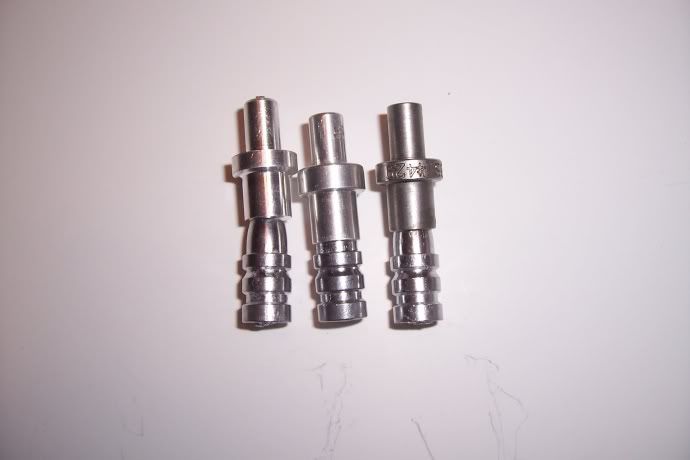
The primary rationale for a nose punch test is that the nose first sizing of the Lee die pumps out "well-centered and square" bullets more often than the Lyman.  Could a loose fitting nose punch in the Lyman cause the bullets to be less accurate?  It's an easy enough test.  Here's the lineup of nose punches with a 358-477:


The flat punch is my standard, it is widely accepted as affective so it made sense to use it.  The deep fit / snug fit middle punch came with a NOE mould.  It also makes sense to give it test and see if there's any improvement in the Rossi.  The RCBS sits in between, but is loose fitting with not much more support than the flat punch.  I included here as a visual reference to show just how deep and snug the test punch is.

I loaded up test loads using 5.4 grains of Unique, using the deep seating NOE punch and headed to the range.  Using the same 2X scope as before, I didn't expect much.  This exact same load was a dissapointment every time I shot it in the Rossi.  So how did it do?  Here are the two best groups, the single flyer in each is shooter induced (sorry about that, I'm only human after all... with no Ransom Rest):


So much for low expectations.  The bottom 4 shot single hole (above the dime, excluding the fifth flyer) measure .190 inches, center to center.  That is the single best group I've ever shot.  Ever.

A quick recap: the 358-477, when sized with the Lyman & a loose nose punch, or the Lee, doesn't group from the Rossi lever action.  There is no before picture, so just think "swiss cheese" and randomly placed holes.  I change the punch to a deep fit / snug fit punch to see what happens.  This bullet goes from zero to hero, unseating the Lee TL 358-158-SWC as the most accurate in the Rossi. WOW!

  • The improvement comes from the bullet being centered while running through the sizer, and being very square and straight as it's sized. 

It's time for the next step, how would this work with the beautiful 180 grain, 358-429 Keith bullets cast with my new custom Mountain Mold.  First, the punch lineup:


The flat punch produces good results with this large meplat bullet, with groups less than 1 inch, at 25 yards & off a rest.  How does the deep fit / snug fit NOE punch affect accuracy. 


These are two different loads. On top is a 5 shot group with13.5 grains of H110.  Very impressive, the real story is the bottom .  It's a 4 shot group (I ran out of test bullets) and my very first revolver group less than .5 inch.  That's pretty special in my book, rarified air IMHO.  It is now the number one most accurate bullet and load, measuring .380 inches, center to center.  WOW AGAIN!

These are spectacular results.  The problem is, my one NOE custom nose punch isn't very helpful to you or anyone else.  It doesn't help me either, with new bullet besigns in the future that need a different size punch.

Luckily, I recently came across Keith Benedict and his unique nose punches.  I've just order 4 for future use.  He offers standard nose punches for a many calibers.  What's so different about his "open" design punch:


They are open so then can be filled with epoxy, or hot glue, and then form fitted to a specific bullet.  That gives a deep fit / firm fit, every time, for any bullet.  If the standard nose punch doesn't quite meet your needs, you can order one custom sized one.

I'm not connected with Keith or his busness.  This is the best solution I've found and need to pass the info along.  You can contact him directly at keiththeperfessor@gmail.com and he will provide all the information needed.  Including instructions.  If you have a loose fitting nose punch, it may work with epoxy or hot glue, give it a try with what you have.

Either way, taking advantage of a deep fit / snug fit nose punch for maximum accuracy makes good sense.


Saturday, November 5, 2011

Mountain Molds Custom 3 Cavity SWC, 358-429 Keith Style

For folks that can't seem to get a 358-429 mould that drops full diameter bullets, here is one great solution.

The last couple of Lyman 358-429's that I bought cast .356-.357 bullets.  Too small to be lapped, especially since they are made of a steel/lead material.  It's too difficult to lap them to .3604 or so, which my guns like sized to .360.

My NOE mould 5 cavity is awesome, but it's only run once a year so you can't order one right now!  There are a few places that can help you out.  Mountain Molds is one of the most unique, with an online design tool.  There are ton of options and measurements that can be changed to make the mold you want.  If the tool can draw it, Mountain Molds can make it.

My new custom 358-429 shoots as great as bullets cast from the NOE and Lyman moulds.  It's one of the top bullets, one of the most accurate and it loves magnum full-house loads.  It is 100% of everything I had hoped for and expected. I did tweak it for a wider meplat, it's a beefed up Keith! 

Before I get to the details, here's a quick look at the top 3 designs that I've found:


A quick review of these great bullets, from left to right:
  1. Lyman 358-477:  The 150 grain mould came already dropping nicely sized bullets.  To get exactly  the size I want, with my soft alloy, took some minor lapping.  With the softer, and also heavier alloy, it drops 4 160 grain bullets.  I shoot a bunch of these every month.
  2. The Lee TL-358-158-SWC  was easier to lap, since it's aluminum, unlike the steel/lead construction of the Lyman.  This now drops at 168 grains, with the soft & heavy alloy.  The Ruger Blackhawk leads at the lands, unless it gets a heavy dose of Liquid Alox.  It's incredibly accurate.
  3. The last two are both 358-429 bullets.  I didn't have a NOE handy for this picture, because I shot all that I had on hand!
    1. This is the Lyman bullet.  It's a little longer than the NOE, but they are similar.  I used this as the model for my custom Mountain Mold.
    2. This is the bullet from the Mountain Mold.  I wanted a little bigger meplat, specified it using the online tool, and it's right on the money.  It fits the Blackhawk really well, and even cycles in a Rossi Lever Action.  A few more thousanths and it probably wouldn't. You can decide how big you want your meplat.  The orignal Keith was (I believe) .250, this one is also .250.
How do you design your own mould

 Go to Mountain Molds website, and select 35/9mm in the drop down.  The measurements that I used are in this screenshot:

Click on the image to get a full size version, use this for input if you are interested.

It takes some learning but in no time you will be used to the interface.  It's a lot of fun and very easy considering that you are actually designing a bullet mould.

Let me say, this mould is awesome.  Mountain Molds will cut either one, two or three cavity moulds.  Check out the absolutely wonderful sprue plate.  If you enjoy casting as much as I do, it's easy to get excited over the Mountain Mold design.  It's thick, it cuts great and the recessed holes making casting a breeze.  I can cast more bullets with this 3 cavity than most other 4 cavity moulds.

What does a Mountain Mold look like (after casting about 10lbs of bullets):


The RCBS handles fit it, or Lee handles fit as well.  It's easy to cut the sprue, and the bullets just drop out of this mould.


Nice looking vent lines and a big block help make this cast so well.  Note the block size in the design tool screen shot above.


Attention to detail is evident in the alignment pins, and the overall look and feel,  This mould is a joy to cast with.  Now you can get any bullet you want, without having to waiting for group buys.  Modeling a design after a known bullet can get you started quickly.

One of the more important decisions is the diameter.  You must decide if you want the specified diameter to be the maximum or minimum, or in the middle of the tolerances.  I choose for .360 to be the minimum.  Since I size and lube, and my guns love fat .360 diameter bullets, this works.

I'll be working up additional design specs in the near future, stay tuned for those results.

At the beginning, I was concerned that the bullets from my custom mould would not be as accurate as I demand and expect.  After all, testing thousand of rounds, testing endless alloys, unending moulds, lapping, sizing, lubes and alloy temps, it all resulted in a finely tuned set of a few excellent moulds.  

Not to worry.  The design is close enough to the model design, which is proven.  Then adjusted for the diameter my guns want, with my alloy.  It surpasses the accuracy and performance of the others, to make it into the top three bullet moulds.  Gotta love it!

I hope this provides another way to get that bullet you really want.  Now, if you design something your gun doesn't like to shoot,  that's another story.  Stay close to a proven masterpiece (the 358-429 Keith in this case) and tweak to suite your guns, and you'll be one happy casting handloader.

Coming soon there will also be another post regarding testing with nose punches (on a lubrisizer), and how a good fitting punch can improve accuracy.

Have fun, be safe and shoot tight groups!

Sunday, October 23, 2011

Lee 3 Die Set or a Dillon 4 Die Set. Any Difference in Accuracy?

The benchmark for accuracy remains at 25 yards, off a rest.  Sometimes with iron sights, other times with various scopes that I seem to buy and sell off.  I also own and have owned casting and reloading equipment from various manufacturer.  Looking at what I have on hand:  I load 38 Special with Lee Dies (3 die set) and Dillon Powder Measure.  357 Magnum is loaded with  Dillon Dies and Dillon Powder Measure.  Each setup is on it's own toolhead, which makes swapping them out a snap.

I wanted to see if a RCBS lock out die would work into my handloading process for both 38 and 357.  It takes one of the 4 holes, leaving 3 stations for the Lee 3 die set (since I had it already).  Seating and crimping at the same time in the last station.  Before deciding to make the switch, I wanted to see if the Lee Die setup produces ammo with the same accuracy as the Dillon.

It's not exactly and apples to apples comparison, but my goal was to free up a hole for the RCBS.  In an earlier post I noted that the Lee FCD can cause problems.  So I'm not really interested in doing additional tests with a Lee 4 die set, which wouldn't free up a station anyway.  My recommendation is to not use the FCD for oversize cast handloading, which is 100% of what I do.  It's great for jacketed bullets, just not cast.

First, the press and other gear, for handloading 357 magnum and 38 special (for my snub-nose) I really like a Dillon 550:


FYI, I don't have the roller handle or the fancy base.  But this is one awesome press.  It is a manually indexed progressive.  After owning turret presses, and several auto-indexing progressives I've decided this is the way to go.  Very safe, very quick and easy to do a mid-course correction. 

A Dillon 3 die set doesn't include a powder/expander die.  They take a little more time to set than the Lee dies, but are easy to clean.  They come apart and go back together without having to unscrew and reset them.


The powder dies comes with the toolhead, and is one size fits all.  The toolhead with powder die is pretty inexpensive:


Each caliber takes a specific powder funnel.  The one on the left is for most pistols, it expand the brass as well a flares the case mouth.  The same one fits 357 and 38 special, it's pretty convenient.


That is what I used to handload the "Dillon" bullets.  I removed the dies and added this equipment from Lee:

A Lee carbide 3 die set.  It costs less than half of the Dillon dies, and includes a powder through expander too.  Really a great deal and price point.


In place of the Dillon Powder Measure, I used the Lee Pro-Auto Disk.  It cost about half of the Dillon setup, and is another great deal.  The disks make finding a known load quick and easy.  It's surprisingly precise too.


I tested, off a rest with my 6.5 inch Blackhawk, with a 2x scope, using the 358-477 bullets and 3.5 grains of 700X.  My most accurate load.

The question is, are the two setups equally accurate?

My first test, at 15 yards, showed no difference in accuracy.  I shot many groups, sometime the Dillon was better, sometimes the Lee group was better.  They were all close.

At 25 yards there was a more clear pattern, first some pictures:

Typical groups loaded with the Lee equipment:


Now for a couple of typical Dillon groups:


The difference should be obvious, if not clouded by my poor photographic skills.  On average, the Dillon groups are in fact smaller.  

At 25 yards, Dillon handloads range from .25 to .5 inch smaller, 80% of the time.

After adjusting seating and crimp dies to get the most out of the Lee's, that's the bottom line.  At 25 yards, the Dillon loaded ammo begins to show superior accuracy.

If, like me, you want the most accurate handloads, at 25 yards, Dillon wins this one.  If your goal accuracy at shorter distances, Lee will save some money.

So, the RCBS isn't working into the my reloading process.  It was really a thought about "additional" safety.  The standard Dillon setup isn't unsafe in any way, to the contrary, it's a great design all the way around.  Since I'm comfortable with the Dillon, and it's more accurate, that's what I'll continue to use for my daily handloading.


Next up, I recieved my mould from Mountain Moulds.  I used their great online design tool in an attempt to get a Lyman styled 358-429, that drops at a full .360 diameter.  I've cast with it, and shot my initial test groups.  Let me say, this is one fine mould.  Details will be coming...

Have fun and shoot tight groups!  After all, you are shooting a 357 Magnum, the finest of all cartridges.

Wednesday, October 12, 2011

Lyman 358-477 Added to Favorite Bullet Moulds and Loads, with Johnson's Paste Wax Lube or Darr Lube

In the post "Follow up on the Lyman 358-477 and the 358-429" I cover the details of this mould.  It is great to get a new Lyman Mould that drops decent size bullets.  After lapping, this gem of a mould is now being added to Favorite Moulds.  The 6.5 inch Blackhawk is loving these!


Using a Lubrisizer with Darr Lube, NRA or Carnauba Red leaves a clean shiny barrel.  200 rounds and no cleaning needed!  Johnson's Paste Wax as a tumble lube, a personal favorite, also produces great results.  After 100 rounds there may be a slight hint of leading, the Blackhawk likes to lead more than the Taurus.

Use a bronze brush wrapped with a swatch of copper Chore Boy and clean any trace of leading, in less than 30 seconds.  There is no accuracy loss after 100 rounds, but I do need to test after 200 rounds.  I'll get some measurements with 5 shot groups, but 1 ragged hole with 10 rounds at 25 yards is excellent.

Any time the barrel can be completely clean in a minute or two, that's good.  Less than one minute is great.  Needless to say, I'm now using a custom .360 Lee sizer and then tumble lubing with the JPW.  There are posts about Tumble Lubing if you are interested.  There is also a post on how to lap a mould.

A four cavity Lyman Mould, made out of soft steel & lead alloy, can cast a bunch of bullets quickly.  It is a real joy to use.  A little heavy, but holds heat well and drop the bullets easily.  I enjoy casting with this mould, and then handloading & shooting these bullets.

Updated Favorite Bullet Moulds and Lubes:


Favorite MouldsBlackhawkM92 (Rifle)Taurus 66Pre-LappedLapped
358-477 Lyman3.5, 700XN/A**N/A150160
TL-358-158-SWC3.5, 700X3.5, 700X3.5, 700X158168
358-429 NOE13.5, H11013.5, H11011.8, H110168178
TL-358-158-SWC13.5, H11013.5, H11011.8, H110158168
TL-358-158-SWC5.4, Unique3.5, HP-383.5, HP-38158168
358-429 NOE5.1, Unique5.1, Unique5.1, 700X*168178
*5.1 of 700X was with the 168 grain bullet, not for use with the 178 grain lapped version.  Check all loads with your reloading manuals and recipes to ensure they are not over-max-pressure.
**The 358-477 had bad accuracy in the Rossi M92 Carbine.  After several tests I've concluded it isn't a match with this gun.

Getting a 358-477 mould and that drops decent sized bullets can be hit and miss.  But when it's a hit, it's very good.

There will be another follow-up, testing this bullet with H110, with Magnum loads.

Shoot tight groups!  Till next time.

Friday, October 7, 2011

Most Accurate Powder - Poll Results (updated chart as of October, 2011)

Note: Scroll down to see the updated results.

Below is a chart of the poll results.A total of 148 handloaders cast their vote and are represented in the graph below.  Click on the chart to enlarge it.


The question posed on the poll was:


New Poll: When loading for your Handgun, what is the most accurate powder?


If you're going shooting with the goal of the most accurate round for your most accurate handgun. What powder do you grab off the shelf? Some folks have a top 2 or 3 because they load a bunch of different calibers.


This is in your most accurate handgun, you can shoot the wings off of a fly powder.


Original chart posted in 2010:

This poll has continued to add up input for quite some time. Below is an update as of May 8, 2011.  The total number of handloader votes is up to 342:


As of October, 2011 there are now 424 votes cast:


It a surprise that the votes keep rolling in.  Each person (ID) is allowed to vote only once. 

Saturday, October 1, 2011

Follow up on the Lyman 358-477 and the 358-429 and a Mountain Mold Custom Design is on Order

I thought it was time to revisit these moulds, and spend some more time flushing out their potential.  I ordered a new 358-477 from Cheaper Than Dirt.  What a great surprise!  Dropping nice size .3576 and .359 bullets with soft lead, as delivered from the factory.  That's much bigger than the prior mould.  Made of soft steel (steel and lead alloy) the four cavities create a pile of great looking bullets in no time flat.

My guns shoot .360 soft alloy bullets better than anything else.  That soft alloy cast smaller than the "spec" alloys used by the mould manufactures, as a result I expect to have to lap them at least some.  It took some time to get the go through that entire process.  Previously described in detail, here's an overiew:

  1. Before first use, heat cycle the mould, 3 times at 400 degrees
  2. Strip the sprue plate and screws off
  3. Heat the mould and alloy
  4. Pour through some nuts, one over each cavity
  5. Cool and measure, if all the cavities are full size (.3604 across the seam) it's done.  Wash up, and the mould is ready
  6. Lap with 220 grit Wheeler Lapping Compound (from Midway)
  7. Cool down & wash with Dawn
  8. Go back to step 3
It takes a few hours, and is well worth the effort. The lapped mould drops .3604 diameter, 160 grain BHN 8 bullets effortlessly.


Lubed with Darr lube, I loaded up a bunch of 357 brass with 3.5 grains of 700X.  Shooting off-hand at 25 yards matched my best results to date, of any bullet.  That includes the champ, a lapped Lee TL-358-158-SWC.  The lapped 358-477 requires a shorter OAL than the usual.  The Blackhawk can handle these at 1.600, just barely.  There is a little resistance when rotating the cylinder as they fit the chamber "snug".


Lube for Convention Lube Groove Bullets

I've written a lot about using Alox and JPW for bullets with tumble lube grooves.  But that's not all that I use, by any means.  For conventional grooves I also like to use a Lyman Lubrisizer and a .360 sizer.  It pumps out well sized and very round bullets very quickly, that may be worth a post sometime.  The conventional lubes of choice are Darr (homemade), NRA & Carnauba Red, from White Label lube.  Their 2500+ looks like a good one to try too, much like the NRA, but not as soft.  These lubes, and many others from other providers, are excellent-proven products.  Look for a used 450 Lubrisizer and get lubing!  A Star from Magma is a good way to go, if money is no object.  I have a used Lyman 450, it works just fine.

For loads that work with pure Johnsons Paste Wax, that remains a top favorite.  It takes testing to determine if that works the best.  For example, a Keith style bullet with a large deep lube groove doesn't work in my guns, with tumble lube.  At least for full-house loads.  I plan to test the 358-477 with JPW in the upcoming weeks.

In closing on the 357-477, the Blackhawk is loving these with a light load.  Heavier loads remain to be tested.  A huge surprise is that the Rossi M92 20 inch lever rifle doesn't like these one bit.  The Lee TL-358-158-SWC remains the king in the Rossi, at least for now.

Now, the 358-429

I placed an order (Cheaper Than Dirt again) shortly after the great results with the 477 mould.  I heated it up, cast some bullets, and with high exceptions began to measure them.  What a let down, .3555 to .357 inch.  After a couple of tries, I decided the micrometer wasn't lyin' to me.

That's way to much lapping for me, even if it might work.  I'm not sure it would.  I really like the design of this bullet, so it was time to get creative.  I measured and measured the 429 bullets.  Once I had a good idea of the dimensions, it was time to go with a custom mould.  I choose Mountain Molds, who has a nice oneline design tool.

It took some time to get solid measurements for the nose, lube groove and driving bands.  I ended up specifying a 175 grain bullet, the spec alloy being WW.  That'll put my soft lead bullets closer to 178 to 180.  The order was placed last night, here are the specs (you may have to click to be able to read the details):


It takes a combination of measurements and much tweaking.  But I believe it's close to the same measurements as the Lyman.  Needless to say, I'll do a write on the the mould and the results at the range.  I'm excited to have a custom design on order, even if I did make it as much like the Lyman as possible.

Have fun at the range, more results are coming soon.

Saturday, September 3, 2011

Favorite 357 Magnum Bullet Moulds and Loads

Overview

Which cast bullet and load shoots the best, most consistently?  This is about 357 Magnums and how accurately they shoot.  25 yards off a rest & sandbags, measured with calipers, then logged and sorted is how I determine what gets included in the Most Accurate Bullet Moulds and Loads Table.  It's a detailed list of data regarding the best and most accurate bullets. My favorite loads, the best of the best are highlighted later in this post.

Being limited to an indoor range 98% of the time is the primary reason for the distance limitation.  Other indoor shooters often practice at 10 - 15 yards while outdoor shooters often shoot 100 or even 200 yards. With a 6 inch or longer barrel a 357 Magnum is surprisingly accurate at long distances.

Semi Wadcutters, Keith and non-Keith consistently out-shoot all other designs.  When measured center to center, with calipers, that's the way the numbers stack up.  Round-nose bullets, full wadcutters and lead-flat-nose (LFN) bullets all have their following, and their place.  Measuring groups center-to-center produces a clear winner, the SWC.

For example, when shooting off-hand, a full wadcutter may shoot slightly bigger groups (we are talking tenths or hundredths of an inch) than a good SWC.  But in Bullseye the wadcutter may outscore the SWC.  Just because that discipline doesn't measure center-to-center distances.  It scores points based on the wad-cutters bigger clean-cut-hole simply touching a ring.  I hope this a good example of how measuring the accuracy in a different way can provide a different result. 

My Favorite Loads

The 357 Magnum guns listed below are a 6.5 inch Ruger Blackhawk, a 6 inch Taurus 66 and a Rossi 20 inch Lever Action rifle.  It's included for fun, which is what this is all about.  These bullets and loads are what I cast and shoot all the time.  1,000 rounds a month total.


Favorite Moulds Blackhawk Taurus 66 M92 (Rifle) Pre-Lapped Lapped
TL-358-158-SWC 3.5, 700X 3.5, 700X 3.5, 700X 158 168
TL-358-158-SWC 5.4, Unique 3.5, HP-38 3.5, HP-38 158 168
TL-358-158-SWC 13.5, H110 11.8, H110 13.5, H110 158 168
358-429 NOE 5.1, Unique 5.1, 700X* 5.1, Unique 168 178
358-429 NOE 13.5, H110 11.8, H110 13.5, H110 168 178
 Lapped  Pre-Lapped  Lapped
*5.1 of 700X was with the 168 grain bullet, not for use with the 178 grain lapped version.  Check all loads with your reloading manuals and recipes to ensure they are not over-max-pressure.

These two moulds have proven themselves as the most accurate and most consistent for a 357 Magnum.  A few of the loads were found by doing a ton of testing.  Shooting multiple 5 shot groups and thousands of bullets.  The rest were found with using Ladder Testing: Incremental Load Development.  That approach is detailed in a multi-part series previously posted in this Blog.

Lapping is also covered in a prior post, scroll down the posts in the right hand column to find it.

The Longer List

A broader look at all the top bullets and loads is below.  For the additional data columns click on the Most Accurate Loads link at the top of the right column of the Blog.

Mould Weight Group Lube Charge OAL Velocity
360-200-SWC NOE 200 0.570 Darr 3.4, 700X 1.614 730
358-429 NOE 168 0.580 Darr 4.7, HP-38 1.620 900
358-429 NOE 168 0.580 Darr 5.1, 700X 1.620 1,200
TL358-158-SWC Lee** 168 0.590 2L/1MS 3.5, 700X 1.610 860
TL358-158-SWC Lee 158 0.610 2L/1MS 3.5, HP-38 1.610 816
TL-358-158-SWC Lee** 168 0.668 2L/Mi 5.4, Unique 1.610 940
TL-358-158-SWC Lee** 168 0.671 2L/Mi 3.5, 700X 1.610 860
358-429 NOE** 178 0.680 Darr 5.1, Unique 1.620 900
TL358-158-SWC Lee** 168 0.680 JPW 3.5, HP-38 1.610 770
358-429 NOE** 178 0.690 Darr 5.7, Unique 1.620 970
358-477 Lyman 150 0.690 Darr 3.5, 700X 1.620 989
357-446 Lyman 162 0.780 Darr 3.5, 700X Groove 890
358-429 NOE** 180 0.810 Darr 13.5, H110 1.620 1,400
TL-358-158-SWC Lee** 168 0.823 2L/Mi 13.5, H110 1.610 1,410
358-429 Lyman 170 0.850 NRA 11.8, H110 1.620 1,037
358-429 NOE 168 1.000 Darr 11.8, H110 1.620 1,037
TL-358-158-SWC Lee 158 1.100 LLA 5.1 HP-38 1.600 1,129
TL-358-148-WC Lee 148 1.100 LLA 3.5 HP-38 1.400 928
358-429 Lyman 170 1.120 Darr 3.2, 700X 1.620 800
360-200-SWC NOE 200 1.180 Darr 3.0, 700X 1.614 660
360-145-SWC NOE 145 1.200 Darr 3.9 700X Groove 1,020
357-446 Lyman 162 1.300 Darr 11.8, H110 Groove 1,020
358-429 NOE 168 1.300 Darr 11.8, H110 1.620 1,037
140-FN-LBT 140 1.400 Darr 5.8 700X Groove 1,347
** Lapped Mould

The 2L/Mi lube is the Extreme Alox, option 1 per a prior post, shot using the Blackhawk with iron sights.  The Mi is Motor Mica.  Loads listed more than once are results from different revolvers, some with a scope or red dot, some with iron open sights.  Look at the full list using the link to see all the details.

Closing

There are many of designs and moulds not listed.  I've tested a ton of them.  I'm often told that the newer breed of LFN style designs are more accurate than semi-wadcutters, you may hear the same.  However, in a 357 Magnum, the SWC is the most accurate and most consistent design.  Some of the new designs are accurate.  However after shooting many groups, measuring and sorting the results, the SWC wins.  The other bullets that I tested aren't listed because they are less accurate.

You, the shooter, have to do your part when shooting for groups.  Even when using a sand-bag, or other rest, it takes practice and repetition.  It's not a slam dunk to shoot groups less than 1 inch.  Shooting off-hand, unsupported, is even much harder to do.  The bullets and loads that shoot the best groups when rested, also shoot the best off-hand.  Albeit with larger groups.

Have fun, be safe, and shoot tight groups.